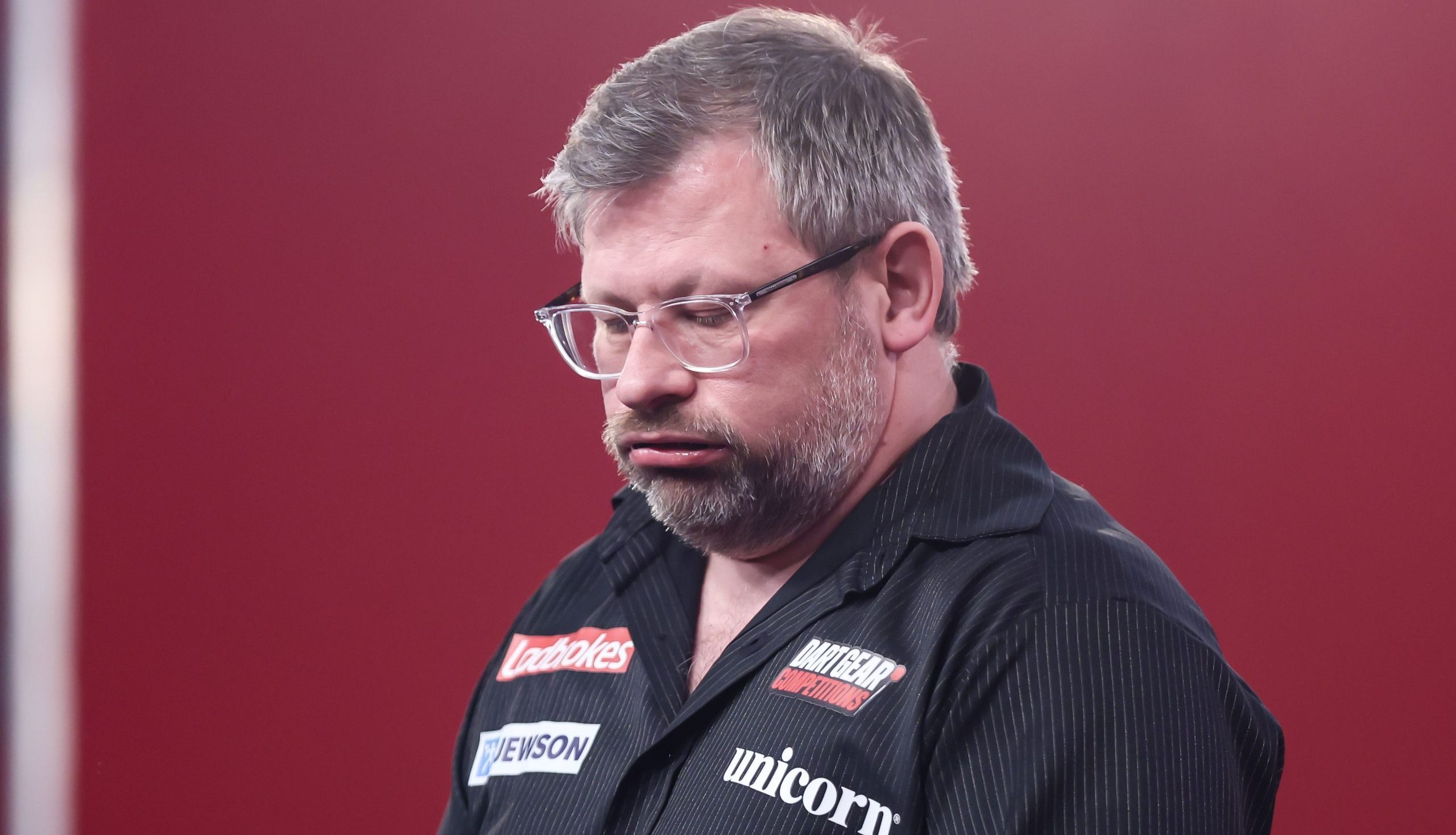
He arrived back on the World Series stage with wins, applause, and the usual darts spotlight—but behind the results, James Wade’s return carried something far less visible and far more human: silence.
Because while the trophies, averages, and post-match interviews tell one story, Wade has now opened up on a very different reality—one that doesn’t show up on scoreboards. A “lonesome” return to the World Series, travelling across cities and arenas, competing at the top level of darts while often doing it completely alone. No entourage. No family presence. Just hotels, airports, and matchdays repeating in a loop.
And that’s where the real pressure begins.
Wade has never been a player defined by noise or drama on stage. He’s built his career on consistency, experience, and a steely ability to compete with anyone in the world. But his recent World Series experience revealed something more personal: even for a veteran with over two decades in the sport, the touring life can still feel isolating.
In Copenhagen, where he returned to World Series action and spoke more openly than usual, Wade admitted that being on the road without companionship has made the experience tougher than expected. Not the darts itself—but everything around it. The waiting, the travelling, the long stretches of downtime in unfamiliar places.
That honesty matters, because elite darts is often sold as pure competition—walk on, throw, win or lose. But Wade’s reflection cuts through that image. The sport might happen in front of thousands of fans, but the life behind it can still feel strangely empty when the walk-off ends.
A return that felt good—but also heavy
From a performance standpoint, Wade’s return to the World Series stage has been solid. He picked up a convincing win in Copenhagen and showed that, even in a sport increasingly dominated by younger high-scoring players, he still belongs in the conversation at major events. (Dartsnews.com)
But what stood out more than the scoreline was his tone afterwards. There was satisfaction, yes—but also reflection. He spoke about being grateful to be invited back into these elite events, describing it as a privilege to be among “the big boys” of the sport again. (Dartsnews.com)
That phrase matters. Because it hints at something deeper: Wade is still fighting for recognition in a sport where momentum, selection, and perception can shift quickly. Even for someone who has won major titles across his career, nothing feels permanently secure.
So when he says it’s “nice to be invited again,” it isn’t just politeness. It’s acknowledgment that top-level darts is competitive not only on stage—but in who gets to stay on it.
The loneliness behind the tour life
The most striking part of Wade’s comments wasn’t about form or selection. It was about solitude.
He openly admitted that travelling alone to World Series events has made things “quite tricky” and “quite hard work,” describing the experience as “quite lonesome.” (Dartsnews.com)
That’s not a word athletes often use in public interviews. It’s not about losing or winning—it’s about the emotional weight of repetition: hotel rooms, airports, practice boards, and match rooms without familiar faces around.
For many fans, that might sound surprising. Professional darts looks social on stage—crowds, music, celebrations—but the reality between matches is often very different. Players travel event to event, sometimes across continents, with long stretches of time spent alone preparing mentally for the next match.
Wade’s comments pull back the curtain on that side of the sport.
And it also raises a broader question: should elite sport still rely so heavily on individual travel and isolation in 2026, especially for tournaments that span multiple countries?
Why Wade’s honesty hits differently
There’s something significant about Wade being the one to say this. He’s not a newcomer adjusting to life on tour. He’s one of darts’ most experienced figures, a multiple-time major champion who has seen the sport evolve from smaller circuits into a global entertainment product.
That gives weight to his perspective.
When younger players talk about travel, it can sometimes be dismissed as adjustment. But when a veteran says it still feels lonely after 25 years in the game, it forces a different kind of reflection.
It also connects to Wade’s broader personality in darts—someone often described as “awkward,” self-aware, and refreshingly blunt about how he sees himself in the sport. He’s never been a media-trained soundbite player. So when he speaks on personal challenges, it tends to feel unfiltered rather than polished.
The bigger picture: success vs satisfaction
What makes Wade’s situation interesting is the contrast between career success and personal experience.
He has won multiple major titles and spent years at the top level of the sport. Yet even with that résumé, he is still chasing moments that feel emotionally complete—not just victories, but experiences that feel shared and meaningful.
That’s where his recent comments become more than just an interview quote. They reflect a common tension in professional sport: success doesn’t always equal fulfilment.
In Wade’s case, the World Series return is both a reward and a reminder. He is still good enough to compete at the top level—but the lifestyle that comes with it can still feel emotionally draining.
And that’s the part fans don’t always see when watching a 15-dart leg or a big checkout.
Opinion: Wade’s honesty should push darts forward
If anything, Wade’s openness should spark a wider conversation in darts.
The sport has grown massively in popularity, prize money, and global reach. But with that growth comes a more demanding schedule and more international travel. For players who are not always surrounded by teams or family members, that can take a real toll over time.
Wade didn’t present himself as struggling in a dramatic sense—he still expressed gratitude, still showed ambition, and still talked about winning titles. But he also highlighted a truth that often gets overlooked: being “on tour” is not the same as being on holiday. It’s work, pressure, and repetition layered together.
And maybe that’s why his words resonate. They don’t sound like complaint—they sound like reality.
Final thought
James Wade’s “lonesome” World Series return is not a story about decline or frustration. It’s a story about the hidden side of longevity in sport.
He is still competing. Still winning matches. Still part of the elite conversation. But he is also experiencing the quieter cost of staying at the top for so long.
And in that honesty, Wade may have said something more important than any result: even in a global sport, the toughest battles are sometimes the ones fought alone between the flights, not on the oche.
Leave a Reply