
In the precision-driven world of professional darts, where every millimeter counts and the flight of three slender arrows can produce moments of pure magic or utter bewilderment, few feats capture the imagination quite like the elusive **Triple Robin Hood**. This spectacular—and statistically improbable—occurrence sees a player’s three darts stack perfectly one into the other, with each subsequent arrow piercing the flight of the previous one, forming a chain-like spectacle that defies the laws of random chance. It is a visual marvel that leaves commentators speechless, fans in awe, and the player often staring in disbelief at a throw that delivers far less on the scoreboard than its wow factor suggests.
For more than a decade, only one man had achieved this rarest of sights on live television: John Bowles, whose memorable effort during the 2013 PDC World Darts Championship etched his name into the sport’s folklore. Bowles, a gritty qualifier who battled his way through the ranks, produced the feat amid the intense spotlight of the Alexandra Palace stage. His throw became the benchmark for impossibility in televised darts, a moment replayed endlessly by enthusiasts and celebrated as a once-in-a-lifetime anomaly. The physics involved—requiring not just pinpoint accuracy but an extraordinary alignment of speed, angle, and spin—made replication seem almost mythical.
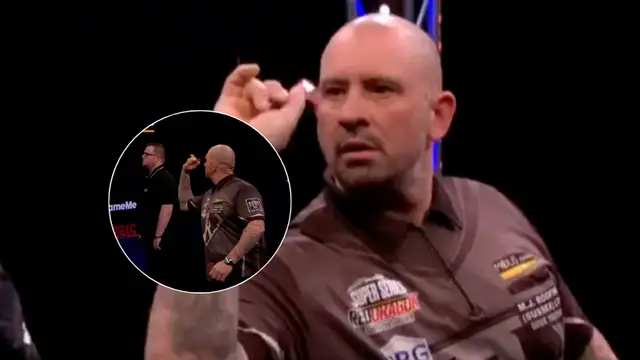
That changed in April 2024 during the MODUS Super Series, a competitive tour known for showcasing emerging and established talent in high-stakes group-stage action. English player Rob Collins, then 45 years old, found himself locked in a tight contest against Adam Lipscombe. In the fourth leg of what would ultimately become a 4-3 victory for Collins, the drama unfolded in breathtaking fashion. Collins opened his visit with a solid treble 20, setting a promising tone. But as he released his second dart, it struck with uncanny precision—not into the board’s scoring area, but directly into the flight of the first dart, embedding itself firmly. A classic Robin Hood.
Then came the third and final dart of the throw. With the same effortless motion that defines professional technique, Collins sent it hurtling forward, only for it to lodge perfectly into the flight of the second arrow. All three darts now formed a single, intertwined column protruding from the board. The result? A mere 60 points instead of the potential maximum 180 that a clean set of three treble 20s would have delivered. Yet the aesthetic triumph overshadowed the scoring disappointment entirely.
Commentators, caught completely off guard, captured the raw astonishment of the moment perfectly. One exclaimed in disbelief, “Oh my words. I don’t think I’ve ever seen a double Robin Hood.” His colleague instantly elevated the call: “It’s the triple Robin Hood.” The MODUS Super Series social media team echoed the excitement when sharing the clip, writing, “OH MY GOD!! WHAT HAVE WE JUST SEEN?! ‘IT’S A *TRIPLE* ROBIN HOOD!!! WHAT ARE THE CHANCES?!”
Fans online reacted with a mix of shock, humor, and admiration. Suggestions poured in that the feat deserved special recognition—perhaps counting as a 180, or earning double points for its sheer rarity. One witty observer joked about the odds being so slim it felt like asking a genie for three perfect darts and receiving something even more extraordinary. Others simply marveled at the visual poetry: three arrows chained together like a miniature feat of engineering on a dartboard.
What makes the Triple Robin Hood so vanishingly rare is the combination of skill, luck, and physics required. A single Robin Hood—where one dart sticks into the flight of another—is already uncommon enough to draw cheers and replays. Doubling that effect demands the second dart to sit just right for the third to follow suit, all while maintaining the velocity and trajectory needed to penetrate without deflecting wildly. In a sport where players train thousands of hours to group darts tightly within a tiny treble bed, this level of stacking remains an outlier even among the elite. Bowles held the solitary televised honor for over ten years, making Collins’ accidental masterpiece only the second recorded instance in broadcast history.
The incident highlighted the unpredictable charm of darts. While nine-darters and 180s represent the pinnacle of scoring perfection, these quirky anomalies remind spectators that the game is as much about human fallibility and freak alignments as it is about calculated brilliance. Collins, far from being frustrated by the lost points, became an instant part of darts lore alongside Bowles. The clip spread rapidly across social platforms, drawing millions of views and reigniting debates about the rarest throws in the sport’s long history.
Beyond the entertainment value, such moments underscore the evolution of professional darts. From the smoky pubs of its early days to the polished television productions of today, the sport continues to produce unforgettable visuals that transcend mere competition. Rob Cross, a former world champion, has even demonstrated the ability to intentionally craft a Triple Robin Hood in challenge settings within seconds, proving that top-level accuracy can push boundaries when practiced deliberately. Yet in competitive play, under pressure with everything on the line, the feat remains almost mythical.
As the darts calendar rolls on with Premier League nights, world championships, and various tours, fans eagerly anticipate the next viral sensation. Will another player join this exclusive club of two? Or will Bowles and Collins stand alone as the only ones to have turned an errant grouping into televised immortality? One thing is certain: in a game where the difference between triumph and tragedy can be measured in fractions of an inch, the Triple Robin Hood stands as a testament to the beautiful chaos that makes darts endlessly captivating. It is not just a throw—it is a reminder that sometimes, the most memorable moments come when perfection goes delightfully sideways.
Leave a Reply