
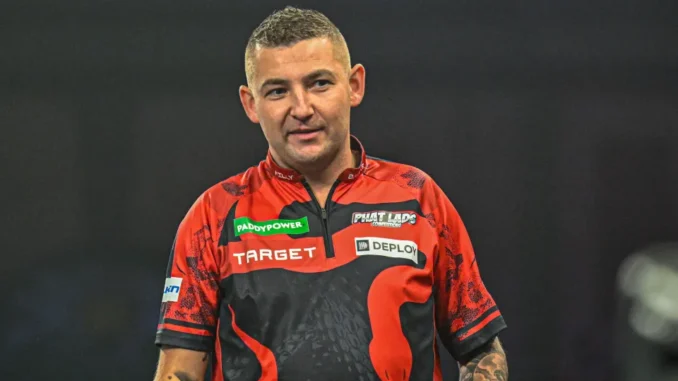
Luke Littler has become the centre of a growing talking point in the darts world after repeated booing from sections of Premier League crowds sparked a fierce defence from fellow professional Nathan Aspinall, who has urged fans to rethink their behaviour and show more respect to the reigning world champion.
Across several Premier League nights this season, Littler has been met with a mixed reception from audiences. While many fans continue to admire his extraordinary talent and rapid rise, a noticeable portion of crowds have chosen to boo him during walk-ons and player introductions. The reaction has surprised some within the sport, especially given the teenager’s status as one of darts’ biggest attractions and most successful modern players.
Despite the negativity from parts of the crowd, Littler has remained remarkably unaffected on stage. His performances have continued to reach elite levels, with consistent high scoring, sharp finishing, and a calmness under pressure that belies his age. In many instances, the hostility has appeared to have little impact on his focus, with the young star responding by raising his level and delivering match-winning displays.
It is this resilience that has prompted Aspinall to speak out strongly in defence of his fellow professional. The former major champion did not hide his frustration when discussing the situation, insisting that some fans need to “sort their heads out” for the way they have treated the teenager. In his view, the criticism and booing have crossed a line, especially considering what Littler has already achieved in such a short space of time.
Aspinall believes that Littler is not only excelling on the oche but also playing a major role in transforming the sport itself. According to him, the young world champion has brought a new wave of attention to darts, attracting younger audiences and boosting the game’s popularity across a broader demographic. He argued that this impact should be recognised and appreciated rather than met with hostility in arenas.
The rise of Littler has been one of the most dramatic developments in modern darts. Breaking onto the scene as a teenager, he quickly established himself as a generational talent capable of competing with the very best in the world. His rapid ascent from promising youngster to world champion happened in a remarkably short time, shocking even seasoned professionals and long-time followers of the sport.
Since then, Littler has continued to build on that success with a series of dominant performances across major tournaments. His ability to consistently produce high averages and deliver under pressure has separated him from many of his rivals. Even experienced opponents have struggled to contain him when he is in full flow, as he often produces scoring bursts that swing matches decisively in his favour.
However, with such dominance has come increased scrutiny and, in some cases, division among fans. Some observers believe the boos stem from a natural sporting reaction to a dominant figure, where supporters often prefer underdogs or closer competition. Others suggest that Littler’s rapid rise and confidence on stage may have contributed to a polarising perception among certain sections of the crowd.
There is also the emotional intensity of rivalries within darts to consider. Matches involving Littler often carry extra weight due to his status and the presence of established stars such as Luke Humphries, Michael van Gerwen, and Gerwyn Price. These encounters frequently produce charged atmospheres, where crowd reactions can become louder and more partisan, sometimes resulting in boos aimed at the young champion.
Despite this, Aspinall insists that the level of negativity directed at Littler has gone too far. He emphasised that the teenager is still very young and already carrying immense pressure as the face of modern darts. In his opinion, very few players in the sport’s history have dealt with such expectations while maintaining such a high level of performance.
One of the most striking aspects of Littler’s game is his composure. Even in the most intense environments, he rarely appears rattled. Whether facing loud crowds, experienced opponents, or high-stakes matches, he maintains a calm and focused approach that allows him to execute his game plan effectively. This mental strength has quickly become one of his defining qualities.
Littler’s achievements already place him among the elite names in darts history despite his age. He has captured major titles, including world championship success, and has built a reputation as a player capable of dominating tournaments. His consistency at the highest level has led many to believe he is not just a rising star, but already one of the sport’s leading figures.
With that success has come enormous expectation. Every time Littler steps onto the stage, he is now viewed as one of the favourites to win. Opponents prepare for him with heightened intensity, and crowds often arrive expecting to see either another dominant performance or an upset against him. This dynamic has contributed to the increasingly emotional reactions seen in some venues.
Interestingly, Littler himself has shown little concern about the boos. He has often brushed off the crowd reaction, suggesting that it does not affect his concentration or performance. On occasion, he has even responded with a relaxed attitude, implying that continued success is the best response to any negativity he receives from the stands.
That mindset has only strengthened his reputation as a mentally tough competitor. Despite his age, he appears to have developed the resilience of a seasoned professional, able to block out external distractions and focus entirely on the task in front of him. This ability has become one of the key reasons for his sustained success at the top level.
Beyond individual performances, Littler’s influence on darts as a whole has been significant. Television ratings have risen, live event attendance has increased, and the sport has gained a surge of interest from younger fans who see him as a relatable and exciting figure. His presence has helped modernise the image of darts and expand its reach beyond traditional audiences.
This broader impact is part of why Aspinall and others in the sport feel strongly about the situation. In their view, Littler represents not just a top-level competitor but also a key figure in the growth of the game. For that reason, they believe he should be supported and celebrated rather than subjected to persistent booing.
As the Premier League season continues, attention remains firmly on how Littler will respond to both the pressure of competition and the reaction from crowds. So far, he has shown no signs of being affected in any negative way. Instead, he continues to perform at an exceptional level, winning matches, producing standout moments, and reinforcing his position as one of the sport’s brightest stars.
If anything, the situation appears to have added another layer to his already remarkable journey. Rather than being unsettled by the crowd hostility, Littler seems to have used it as further motivation to maintain his dominance. With his talent, mentality, and consistency, he remains firmly on track to shape the future of darts for years to come.
Leave a Reply