
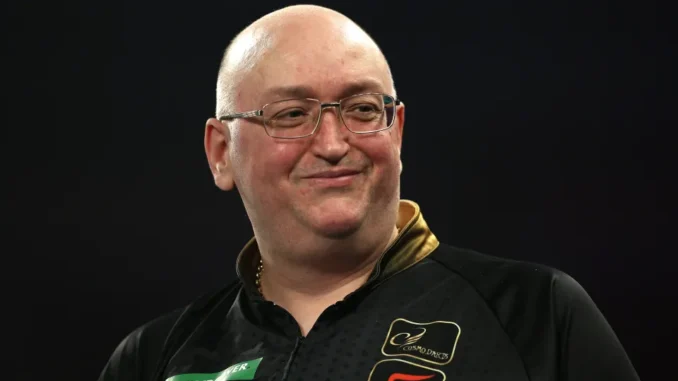
Andrew Gilding’s latest triumph on the professional darts circuit has added another unexpected chapter to one of the sport’s most quietly compelling careers, after the Englishman revealed that a surprising change in his body weight may have played a part in ending his long wait for a Players Championship title.
The 55-year-old, who once worked as a butcher before establishing himself on the professional tour, produced a composed and clinical display in Leicester to defeat experienced Welsh star Jonny Clayton 8-3 in the final. The victory secured him the Players Championship crown and a £15,000 prize, marking a significant milestone in a career built on patience, persistence, and gradual improvement rather than overnight success.
For Gilding, the win was not just another addition to his record but a reminder of how unpredictable darts can be. Despite years of competing against some of the sport’s biggest names, he has often operated under the radar, rarely attracting the spotlight reserved for more flamboyant or high-profile players. Yet when the opportunity arose in Leicester, he seized it with authority, producing a series of confident performances that culminated in a dominant final showing.
What has made the victory particularly intriguing is Gilding’s own explanation for his form. In a candid post-tournament reflection, he admitted that a noticeable increase in his body weight may have had an unexpected influence on his performance. The darts professional revealed that he had gained close to two stone in recent times, a change he believes could have contributed in ways he did not anticipate.
“I don’t know what’s changed really,” he said after lifting the trophy. “I’ve managed to keep my practice up. I’ve put on a bit of weight. I thought losing weight helped me win before, but I’ve put on nearly two stone since then.”
His remarks have sparked discussion within the darts community, not because of any dramatic transformation, but because they highlight the unpredictable nature of form and performance in elite sport. Unlike disciplines where physical conditioning is the dominant factor, darts often blends technical skill, mental resilience, rhythm, and confidence in ways that are difficult to quantify. Gilding himself appeared reluctant to draw firm conclusions, instead suggesting that his success is the result of a combination of factors rather than any single change.
“Your form dips, your form rises,” he added. “You’ve just got to be patient.”
That patience has certainly been a defining feature of his career. Gilding’s journey to the upper levels of darts has been long and gradual. Before turning fully professional, he balanced work outside the sport with competing on the circuit, slowly building ranking points and experience over many years. Unlike many of today’s rising stars who emerge as teenagers, Gilding’s path has been shaped by steady development rather than rapid ascent.
His latest success in Leicester, however, shows that persistence can eventually pay off in spectacular fashion. Throughout the tournament, Gilding demonstrated the kind of composed finishing and steady scoring that has become his trademark. In the quarter-finals, he produced one of his strongest performances of the season, averaging just over 103 in a confident win over Joe Hunt. That display signalled that he was in strong form and capable of challenging for the title if he maintained his consistency.
In the semi-final, he faced a sterner test against experienced competitor Ian White. The match was more closely contested, with both players exchanging momentum at various stages. However, Gilding’s calm under pressure proved decisive as he held his nerve in key legs to secure his place in the final.
The final itself saw him take control early against Jonny Clayton, a player with a proven track record in major tournaments. Clayton, known for his scoring power and resilience, struggled to find his rhythm as Gilding applied steady pressure throughout the match. The Englishman capitalised on key opportunities, punished missed doubles, and maintained a level of consistency that his opponent could not match over the course of the contest.
By the time the final leg was secured, the result felt like a culmination of everything Gilding had built over years on the circuit. While it may not have carried the shock factor of his earlier major breakthrough, it reinforced his reputation as a dangerous and capable competitor on any given day.
Elsewhere in the tournament, several of the sport’s biggest names endured unexpected early exits, a reminder of how competitive and unpredictable the Players Championship circuit can be. High-profile players struggled to find consistency on the day, allowing lower-ranked competitors to progress deeper into the draw. These upsets opened the door for players like Gilding to capitalise, but the manner of his victory suggested more than just a fortunate draw. His level remained consistently high throughout the event.
Gilding’s story continues to stand out in modern darts because it contrasts sharply with the sport’s newer generation of rapid success stories. While many top players rise quickly through youth systems and televised breakthroughs, his journey has been defined by longevity and perseverance. Before establishing himself as a full-time professional, he worked as a butcher and also held factory jobs, balancing everyday employment with competitive darts commitments.
That background has often been cited as part of what makes his success so relatable to fans. He represents the idea that persistence and dedication can still produce results in a sport increasingly dominated by young, highly polished professionals. His previous major breakthrough came two years earlier when he famously captured the UK Open title, a victory that surprised many observers and announced him as a genuine threat on the big stage.
Since then, he has continued to build steadily, maintaining a place among the world’s top-ranked players and regularly reaching the latter stages of tournaments. His latest Players Championship win now adds further weight to his growing list of achievements and reinforces the idea that his UK Open triumph was no isolated moment of success.
Now firmly established inside the world’s top 30, Gilding has developed a reputation as one of the most consistent and quietly effective performers on tour. While he does not always attract the same attention as more outspoken or flamboyant players, his results speak for themselves. He is capable of producing high averages, holding his nerve in tight matches, and taking advantage of opportunities when they arise.
The unusual detail about his weight gain has added a human and somewhat humorous dimension to his story, but it is unlikely to define his success. In reality, his victory in Leicester appears to be the result of sustained effort, experience, and timing coming together at the right moment. Darts is a sport where confidence and rhythm often matter more than physical conditioning, and Gilding seems to have found both in abundance during the event.
As the season progresses, the question now is whether he can build on this momentum. With ranking points and qualification spots for major tournaments still on the line, consistency will be key. If he can maintain the level shown in Leicester, further titles may well follow.
For now, though, his Players Championship victory stands as another reminder of the unpredictable beauty of darts. Careers do not always follow straight lines, and success does not always come in expected ways. In Gilding’s case, patience, persistence, and perhaps even an unexpected change in physique have combined to deliver one of the most memorable wins of his career.
Leave a Reply