
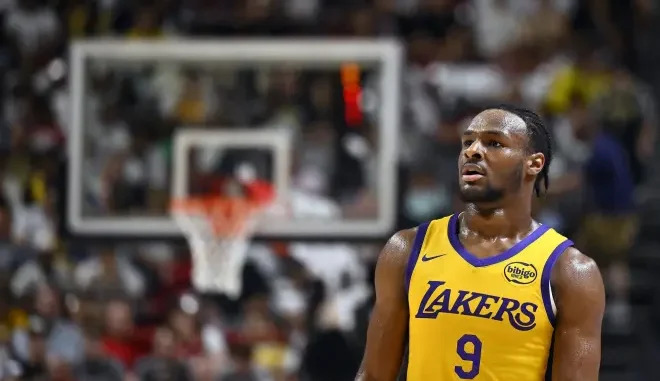
The conversation surrounding LeBron James has entered a fascinating new phase, one that blends legacy, performance, and the realities of time. For the Los Angeles Lakers, the question is no longer just about how far LeBron can carry them, but whether a new dynamic—featuring his son, Bronny James—can help bridge the gap between past dominance and present challenges.
LeBron’s greatness has never been in doubt. Even deep into his 40s, he continues to produce numbers that most players would consider peak output. Night after night, he remains the focal point of the Lakers’ offense, orchestrating plays, attacking the basket, and stepping up in clutch moments. His ability to read the game, combined with his physical presence, still makes him one of the most influential players on the court.
But the context around those performances is shifting. LeBron himself has acknowledged that maintaining such a high level is becoming increasingly demanding. Injuries that once might have been minor inconveniences now linger longer, subtly affecting his explosiveness and recovery time. There are stretches where his efficiency dips, or where the physical toll of consecutive games becomes more visible. These are not signs of decline in the traditional sense, but rather reminders that even the greatest athletes must adapt.
For the Lakers, that adaptation is critical. The team has long relied on LeBron as its central pillar, but the modern NBA demands depth and versatility. Opponents are quicker, rotations are tighter, and the margin for error is smaller than ever. That reality has sparked discussions about how the Lakers can reduce the burden on their superstar while remaining competitive at the highest level.
This is where Bronny’s presence becomes more than just a symbolic milestone. Sharing the court with his father has already created one of the most memorable narratives in basketball history. The image of a father and son competing together at the highest level carries emotional weight, but it also introduces practical questions about fit, role, and contribution.
Bronny has shown flashes of the qualities that made him a highly regarded prospect. Defensively, he brings energy and awareness, often positioning himself well and showing a willingness to engage in physical play. His athleticism is evident in transition, where he can keep pace with the game’s tempo and make smart decisions with the ball. These traits have earned him praise from coaches and teammates alike, particularly given the pressure that comes with his name.
However, the offensive side of his game remains a work in progress. At times, he has appeared hesitant to assert himself, especially in perimeter shooting situations where confidence is key. In a Lakers system that relies heavily on spacing to maximize the effectiveness of players like LeBron, that hesitation can limit his impact. There have been games where his contributions have been modest, reinforcing the idea that he is still developing rather than ready to take on a major role.
The broader context of the Lakers’ season adds urgency to these questions. Injuries to key players have disrupted the team’s rhythm, forcing adjustments in rotations and placing additional pressure on those available. In such situations, younger players often find themselves thrust into more prominent roles, whether they are fully prepared or not. For Bronny, that has meant navigating moments of opportunity alongside the inevitable learning curve.
The idea of him being the “missing link” is both intriguing and somewhat unrealistic. On one hand, his development could provide the Lakers with a valuable two-way guard, someone capable of contributing defensively while gradually expanding his offensive repertoire. On the other hand, expecting him to immediately solve the team’s structural issues overlooks the complexity of those challenges.
LeBron’s role in this dynamic is equally compelling. As a father, his pride in sharing the court with Bronny is unmistakable. As a competitor, his focus remains firmly on winning. Balancing those two perspectives is no small task, especially in the high-pressure environment of the NBA. Every decision, from rotations to shot selection, is scrutinized, and the presence of a family connection only intensifies that spotlight.
There is also a psychological dimension to consider. For LeBron, playing alongside his son represents the fulfillment of a long-held dream, but it also comes at a time when his own career is entering its final chapters. That juxtaposition—of legacy and transition—adds a layer of complexity to every game. It raises questions about how much longer he can maintain his current level and what the future of the Lakers might look like once he steps away.
For Bronny, the challenge is different but no less significant. He is not only trying to establish himself in the league but doing so under unparalleled scrutiny. Every performance is compared not just to his peers but to the legacy of his father. In that sense, his journey is as much about carving out his own identity as it is about contributing to the team.
Within the locker room, the focus remains pragmatic. The Lakers are chasing results, and that means every player must earn their role through performance. Bronny’s minutes, like those of any young player, are likely to fluctuate based on matchups, form, and the team’s immediate needs. This approach reflects the reality of a franchise with championship aspirations, where sentiment cannot outweigh strategy.
Despite the uncertainties, there are reasons for optimism. LeBron’s continued excellence provides a foundation that few teams can match, while the presence of emerging talent offers the potential for growth. The challenge lies in aligning those elements effectively, ensuring that the team evolves without losing its competitive edge.
As the season progresses, the narrative will continue to evolve. Some nights will highlight the enduring brilliance of LeBron, others will showcase the gradual development of Bronny, and many will underscore the complexities of building a winning team in a league defined by constant change.
The question of whether Bronny is the missing link may not have a definitive answer anytime soon. What is clear, however, is that his presence adds a new dimension to the Lakers’ story—one that blends history, expectation, and the pursuit of success.
For now, the Lakers remain a team in transition, guided by a legend who refuses to fade and supported by a new generation still finding its footing. Whether that combination ultimately leads to championship contention will depend on how quickly those pieces come together and how effectively they adapt to the challenges ahead.
Leave a Reply