
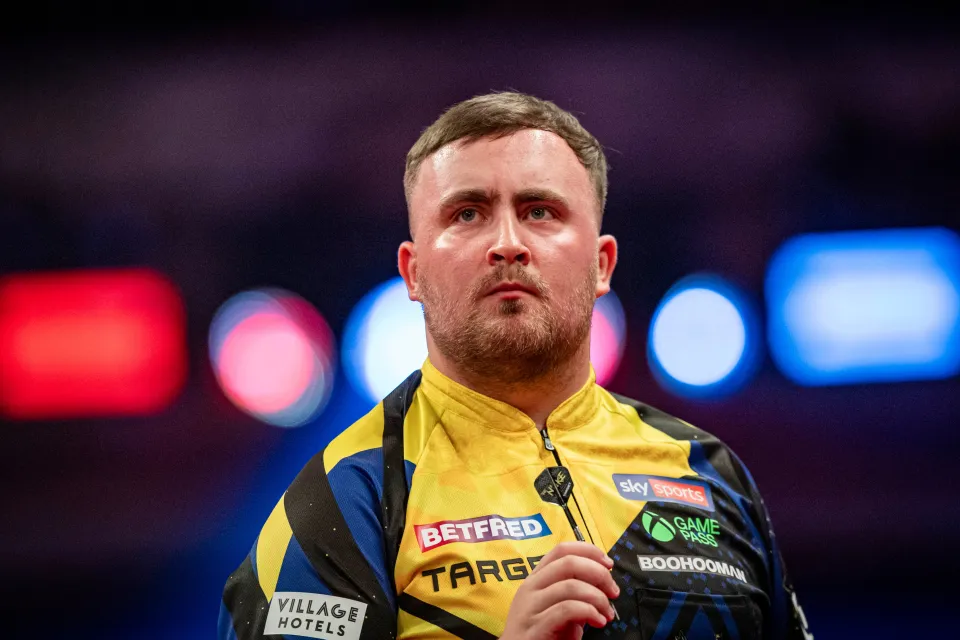
Luke Littler has once again become the center of a darts debate, but this time it is not because of another spectacular trophy run. His decision to step away from events in the Netherlands has raised questions about how much professional darts the world No.1 actually needs to play — and one prominent pundit believes fans should get used to seeing less of him.
Paul Nicholson has backed Littler’s reduced schedule, insisting that selective appearances are nothing new for the sport’s biggest stars. His comments come after Littler withdrew from Players Championship 29 and 30 in Den Bosch following a turbulent weekend at the World Series of Darts Finals in Amsterdam.
For a player who has spent much of 2026 looking almost unstoppable, the decision is fascinating. Littler is not simply another professional trying to maximize his ranking points. He is already the sport’s biggest attraction, and he has reached a stage where he can afford to be extremely selective about where and when he competes.
The Amsterdam controversy changed the conversation
Littler arrived in Amsterdam with history within reach. Having already won the first six premier PDC events of the season, he was chasing a clean sweep that would have been unprecedented.
Instead, Jonny Clayton ended that dream with a 10-4 quarter-final victory. But the result was arguably not the biggest story surrounding Littler that weekend.
The 19-year-old was repeatedly booed and whistled during matches against Danny Noppert and Nathan Aspinall, with referee Charlie Corstorphine intervening during the Aspinall contest. Littler subsequently suggested he could avoid future Dutch events if the treatment continued.
His frustration was clear.
“With the Germans, I haven’t been for a long time. We will have to see in Dortmund whether it changes or stays the same. If the Dutch stay like this, then I’m not going to do any Euro Tours over there.
“There’s just no point in me travelling, wasting my time while I’m getting booed. I just want to play my darts, obviously sign autographs.”
Then came the decision to pull out of the two Players Championship events in Den Bosch.
Nicholson says this isn’t new
That is where Nicholson’s comments become particularly interesting.
The former major winner has previously argued that Littler’s selective approach to the calendar is understandable, and his latest comments continue that line of thinking. Nicholson pointed out that Littler’s reduced schedule should not automatically be interpreted as something negative for darts.
In fact, Littler has already been selective throughout 2026. He skipped the first 26 Players Championship events of the season before appearing in September.
Nicholson’s wider argument is simple: the sport has changed.
The biggest players now have enormous opportunities outside the traditional floor events, while major televised tournaments carry far greater attention, prize money and commercial value.
That does not mean the ProTour is irrelevant. But for somebody operating at Littler’s level, there is a legitimate question over whether playing every available event provides enough benefit to justify the physical and mental demands.
And that is why the “it’s not new” argument carries weight.
Littler isn’t the first elite player to protect his schedule
Darts has seen elite players become increasingly selective as the sport has expanded.
The modern calendar is relentless. Players are expected to travel internationally, compete in floor tournaments, appear at televised majors, fulfil media obligations and deal with the enormous expectations that come with being a household name.
Nicholson himself has highlighted how selective scheduling can help players remain fresh for major competitions. Littler was expected not to play every Players Championship and European Tour event this year.
That makes the idea of Littler skipping certain events much less surprising.
There is also an important distinction between “quitting darts” and “quitting some events.”
Those are completely different things.
Littler has not announced that he is walking away from the sport. Far from it. His schedule still includes the World Grand Prix in Leicester, the European Championship, further Players Championship events, the Grand Slam and the Players Championship Finals period.
And the World Grand Prix is particularly significant because Littler enters as defending champion.
That is where fans will see the real test of whether his selective approach works.
The bigger issue may actually be the crowds
There is another layer to this story that should not be ignored.
Nicholson did not simply dismiss the crowd controversy. He explained why players can find whistling especially disruptive.
“We have seen Littler have some banter with the crowd, which we’re all for by the way, because we want people to have that connection. One of the greatest things about this sport is that there is a connection between the fans and the stars.”
But he also explained that whistles are different from ordinary booing because of how sharp and unpredictable they can be.
That distinction matters.
Darts depends heavily on concentration and repetition. A player can deal with noise, singing and conventional crowd hostility, but a sudden whistle during the throwing motion is a different challenge.
Whether every fan agrees with Littler’s response is another matter. Some will argue that playing in front of hostile crowds is simply part of becoming a superstar. Others will say players should not be expected to accept behavior that interferes with the actual throw.
Both sides have a legitimate argument.
Littler is changing what an elite darts career looks like
This is perhaps the most fascinating part of the entire story.
Littler is still only 19, yet his achievements have already given him a level of freedom that most players spend their entire careers trying to reach.
He does not need to prove that he belongs among the elite. He has already won world titles and major championships, and his 2026 campaign has established him as the dominant figure at the top of the sport.
That changes the calculation.
If Littler believes missing a few floor events helps him arrive at the biggest tournaments fresher, sharper and more motivated, there is a strong sporting logic behind that decision.
Of course, there is a downside.
Every event Littler skips gives somebody else an opportunity. His absence opens the door for players such as Jonny Clayton, Ross Smith, Luke Humphries, Gerwyn Price and Michael van Gerwen to collect titles and ranking money.
That could ultimately make the competitive landscape healthier.
But it also means fans will have to accept something they are probably not used to yet: they will not see Luke Littler everywhere.
And perhaps that is exactly the point.
The next chapter starts in Leicester
Littler’s next major appearance comes at the World Grand Prix. After the chaos of Amsterdam, the spotlight will be firmly back on the board.
There will be no clean-sweep dream hanging over him, but there will be the pressure of defending another major title.
Nicholson clearly does not want Littler disappearing from the sport. His message is more nuanced: learn from the experiences of other players, manage the schedule intelligently and avoid allowing crowd confrontations to dictate the direction of an entire career.
That feels like the real story here.
Littler is not running away from darts. He is deciding which parts of the darts calendar deserve his time.
Whether that proves to be the right approach will become clearer as the biggest tournaments arrive. But one thing is already obvious: Luke Littler has reached a level where even choosing not to play has become a major darts story.
And honestly, that says almost as much about his position in the sport as another trophy would.