
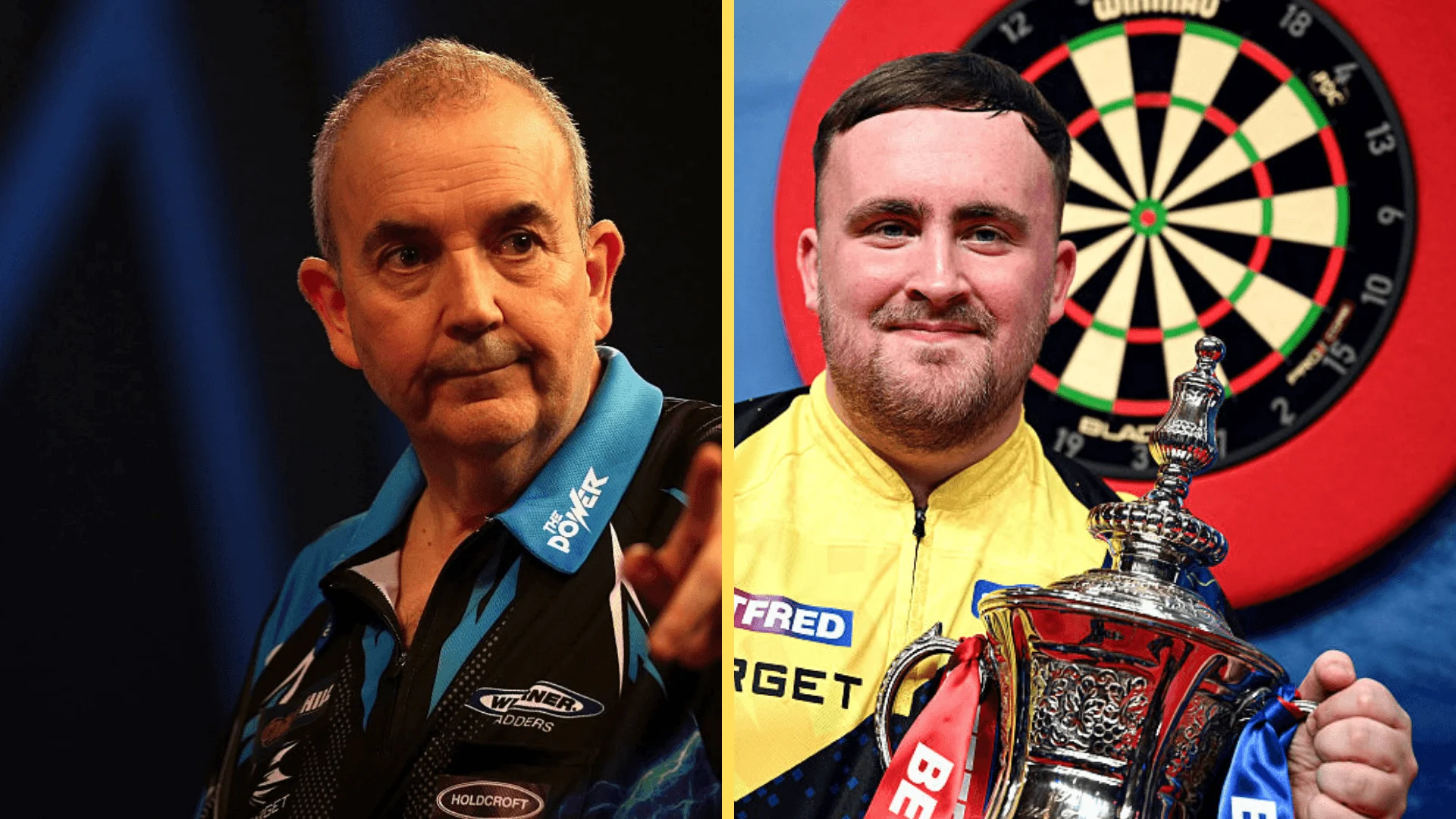
Luke Littler has already reached a level in darts where his biggest challenge may no longer be proving that he is good enough. Instead, the question is whether he can sustain this extraordinary standard for years without allowing the demands of professional sport to eventually catch up with him.
That is where Phil Taylor’s warning carries real weight. The 16-time world champion knows better than almost anyone what it takes to dominate darts for a long period, and while he has been full of praise for Littler’s extraordinary natural ability, he has also made it clear that talent alone cannot carry a player forever.
Taylor’s message is particularly relevant now because Littler is taking a different approach to the professional calendar. The 19-year-old has deliberately reduced his appearances at some lower-profile events in 2026, prioritising the tournaments that matter most to him.
The Nuke is doing things differently
There is no denying that Littler’s approach has worked spectacularly so far.
The teenager has continued to produce elite performances while being far more selective with his schedule. He has played only two Players Championship floor events this year and entered just three European Tour tournaments, while also skipping the World Series events in Australia and New Zealand.
That is a significant change from the expectation that an elite player should simply turn up everywhere.
Littler has defended the approach by arguing that his position at the top of the rankings gives him the freedom to choose where he plays. He has also openly spoken about needing days away from darts rather than constantly travelling from one tournament to another.
And honestly, it is difficult to argue with the results.
But Taylor has seen this sport consume players before.
Talent can only take you so far
Taylor’s comments about Littler’s preparation are particularly revealing because the two players approach the game very differently.
The Power was famous for his relentless practice habits. Littler, by comparison, has developed a reputation for looking remarkably relaxed before matches.
Taylor recalled watching Littler in Finland and being stunned by how little preparation the youngster appeared to need.
“I said: ‘Are you not taking the practice board with you?’ He’s going down to London and staying in some rented house. He went: ‘No.’”
Taylor then described what happened next.
“Literally, he sat in the room in Finland, he never threw a dart all night, went on stage cold, hit ten 180s and had a 110 average.”
That is the kind of ability that makes Littler so fascinating.
Most professionals would never dream of approaching a major match with that little visible preparation. Littler appears capable of switching himself on almost instantly, and his confidence has become one of the defining characteristics of his game.
Even Taylor admitted his reaction was simple.
“This is crazy. I’d never do that. But that’s his ability. He really is that natural. He’s brilliant.”
That praise matters because it comes from a player who understands exactly how difficult it is to perform at the highest level.
But then came the warning.
“It can catch up on you”
Taylor’s concern is not that Littler lacks talent. Quite the opposite.
His argument is that even extraordinary talent eventually needs to be supported by preparation.
“It can catch up on you, if you don’t put the practice in, like any sport,” Taylor said.
That is a brutally simple message, but it is also difficult to dismiss.
Footballers cannot rely purely on natural ability. Tennis players cannot remain at the top without maintaining their bodies and technique. And even the greatest darts players eventually discover that their opponents become stronger, their standards rise and small weaknesses become easier to exploit.
Taylor went further by comparing darts preparation with football training.
“In football if you weren’t training, it can catch up on you, no matter how good you are you still have to put the work in.”
That does not necessarily mean Taylor believes Littler is lazy.
In fact, he suggested almost the opposite.
“I think backdoors, he’s putting the work in. I know everybody says he just walks in and sits there for an hour or two, which he has, but I think beforehand he has had a good practice.”
That is an important distinction.
Littler may simply be practising in ways the public does not see.
His recent schedule suggests he understands his body and mind better than some critics might assume. Rather than filling every available week with tournaments, he has created more space to recover, practise and prepare for the biggest competitions.
And that could ultimately be the smartest part of his entire strategy.
The calendar is becoming brutal
Professional darts is not a sport where the biggest names simply play a handful of major tournaments and go home.
The modern PDC calendar is enormous.
Players travel across countries, compete in floor events, European Tour tournaments, televised competitions and team events, while also dealing with media commitments and commercial opportunities.
For a teenager who exploded onto the global scene at 16, the amount of attention surrounding Littler is another factor.
He is no longer just playing darts.
He is one of the biggest stars in the sport.
That means more interviews, more appearances, more travel and more expectations. There is also the constant pressure of being expected to win almost every time he walks onto a stage.
That makes his decision to protect his schedule understandable.
But there is a delicate balance.
Too much competition can lead to fatigue. Too little can potentially affect sharpness and rhythm.
Littler appears determined to find the middle ground.
The World Grand Prix provides another test
The timing of Taylor’s warning is especially interesting because Littler is about to begin his World Grand Prix title defence.
The tournament begins on September 28 in Leicester, with Littler facing an in-form Luke Woodhouse in the opening round.
The format itself makes the tournament particularly demanding. Unlike most major PDC events, the World Grand Prix requires players to start each leg by hitting a double as well as finishing on one.
Littler has already won this tournament once, and he now has the opportunity to become only the third player to successfully defend the title after Taylor and Michael van Gerwen.
That puts Taylor’s advice into an interesting context.
Littler is not struggling because he is playing too little. He is still producing world-class darts. The real question is whether his unusual approach will remain effective as opponents learn more about him and the competition around him becomes stronger.
The warning is about longevity
Perhaps the biggest mistake would be interpreting Taylor’s comments as an attack on Littler.
They sound much more like advice from one generational talent to another.
Taylor knows what it feels like to become the player everybody wants to beat. He knows the pressure, the travel, the expectation and the enormous amount of work required to remain at the top.
And Littler is already experiencing those pressures at an incredibly young age.
The exciting thing is that he appears to understand that longevity matters.
His selective schedule is not necessarily a sign that he wants less from darts. It could actually mean he wants to remain at the highest level for longer.
Taylor’s warning simply highlights the other side of the equation: rest is important, but so is preparation.
Littler has already shown that his natural ability is extraordinary. The next stage of his career will be about combining that gift with the discipline required to sustain it.
If he gets that balance right, the conversation around his career could become even bigger than it is now.
And with Taylor’s records still sitting as the ultimate benchmark, that long-term question is impossible to ignore.
Littler does not need to become Phil Taylor. But if he wants to chase the kind of longevity and dominance that made Taylor a legend, he will eventually have to prove that natural brilliance and relentless preparation can coexist.
That may be the biggest challenge waiting for The Nuke.