
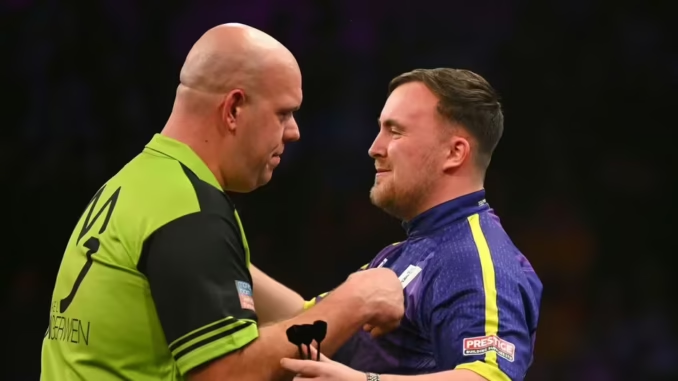
Luke Littler has once again found himself at the centre of attention in the darts world after a playful but intriguing exchange with Michael van Gerwen, who has reportedly given the teenage sensation a new nickname during a recent interaction on the professional circuit. The moment has quickly become a talking point among fans and players alike, not just because of the nickname itself, but because of Littler’s unusually reserved reaction, described by those close to the situation as him “not daring” to respond.
The exchange adds another layer to the already fascinating dynamic between two of the sport’s most prominent figures from different generations. On one side is Van Gerwen, a seasoned champion and one of the most successful players in darts history. On the other is Littler, still in his teens, who has already taken the sport by storm with a rapid rise that has reshaped expectations of what is possible at such a young age.
Their relationship has evolved into something more complex than a straightforward rivalry. It is a mixture of respect, competition, and psychological sparring that often plays out in subtle ways, both on and off the stage. While their matches have delivered high-quality darts and tense finishes, it is the off-stage interactions like this latest nickname incident that continue to fuel discussion and interest.
Van Gerwen is known throughout the sport for his intensity and strong personality. A three-time world champion, he has built his career not only on scoring power and consistency but also on his ability to dominate opponents mentally. Gamesmanship, verbal exchanges, and psychological pressure have long been part of his competitive toolkit. Against Littler, however, the dynamic is slightly different, as the teenager has shown an unusual ability to remain composed in the face of pressure from even the most experienced players.
The nickname itself has not been officially detailed, but its introduction reportedly came during a light-hearted moment between the two players. While Van Gerwen’s tone is understood to have been more playful than hostile, the gesture still carried weight, given his status within the sport. For Littler, who is still navigating the rapid rise in attention and scrutiny, such interactions are becoming increasingly common as opponents test not only his skill but also his temperament.
Those close to Littler have suggested that his reaction was one of quiet restraint rather than confrontation. The description of him “not daring” to respond has been interpreted more as a sign of respect and focus than hesitation or intimidation. Rather than engaging in verbal exchanges, Littler has consistently chosen to let his performances on the oche speak for themselves.
That approach has served him well throughout his breakthrough career. Since bursting onto the professional scene, Littler has delivered a series of standout performances in major televised events, quickly establishing himself as one of the most dangerous scorers in the game. His ability to handle pressure situations, particularly in deciding legs and high-stakes matches, has set him apart from many of his contemporaries.
One of the defining features of Littler’s rise has been his composure. Despite his age, he has shown a remarkable ability to remain calm in front of large crowds and under intense media attention. That composure has become even more important as his profile has grown, with every match now attracting significant scrutiny from fans, pundits, and fellow professionals.
Van Gerwen’s involvement in this latest exchange highlights how highly Littler is now regarded within the sport. Established champions rarely invest emotional or psychological energy into younger players unless they see them as genuine long-term threats. The fact that Van Gerwen is engaging with Littler in this way suggests a recognition of his growing influence at the top level.
Their head-to-head encounters have already produced several memorable moments. Littler has managed to defeat Van Gerwen in high-pressure matches, including tightly contested games that went down to deciding legs. These victories have not only boosted his reputation but also demonstrated that he is capable of competing with—and beating—the very best players in the world.
Van Gerwen, however, remains one of the sport’s most formidable competitors. Even in a period where younger players are beginning to challenge the established order, he continues to be a constant presence in major tournaments and a benchmark for consistency and excellence. His experience in handling pressure situations gives him a unique edge, particularly in long-format competitions where mental resilience is as important as scoring ability.
The nickname incident also reflects a broader culture within darts, where psychological interaction between players is part of the competitive environment. Unlike many other sports, darts often features moments of direct verbal engagement, crowd interaction, and personality-driven rivalry. These elements contribute to the entertainment value of the sport while also influencing performance on the board.
For Littler, however, the focus remains firmly on results. Despite the growing attention surrounding him, he has repeatedly emphasised the importance of staying grounded and concentrating on his game. His team has also worked to ensure that external noise does not distract him from his development as a player.
That discipline has been evident in his performances. Whether facing experienced champions or emerging talents, Littler has consistently delivered high averages, strong finishing, and an ability to produce key moments under pressure. These qualities have helped him rise rapidly through the rankings and establish himself as a regular contender in major televised events.
At the same time, his growing profile has inevitably brought increased attention from opponents looking to unsettle him in various ways. Whether through subtle remarks, on-stage gestures, or off-stage comments like the recent nickname exchange, Littler is now experiencing the full psychological dimension of elite-level darts.
Despite this, he has shown little sign of being thrown off course. Instead, he appears to be embracing the challenges that come with competing at the highest level. Each new interaction, whether friendly or competitive, adds to his experience and helps shape his development as a professional athlete.
The wider darts community has reacted with interest to the latest exchange between Littler and Van Gerwen. Fans are particularly drawn to the contrast between the established champion and the emerging star, seeing their interactions as symbolic of a generational shift within the sport. On one side is experience, authority, and a long history of success; on the other is youthful energy, rapid progress, and a fresh approach to competition.
As the season continues, it is likely that their paths will cross again in high-stakes matches where both pride and ranking points are on the line. When they do, the psychological undercurrent between them will inevitably add another layer of intrigue to an already compelling rivalry.
For now, the nickname incident serves as another small but significant moment in a growing narrative. It highlights how far Littler has come in such a short space of time, how closely he is now being watched by the sport’s biggest names, and how even light-hearted exchanges can carry meaning in the world of professional darts.
And while Van Gerwen may have had his moment of humour or provocation, Littler’s silence may be just as telling. In a sport where words can sometimes carry as much weight as scores, his decision to let his darts do the talking continues to define his rise at the very top of the game.
Leave a Reply