
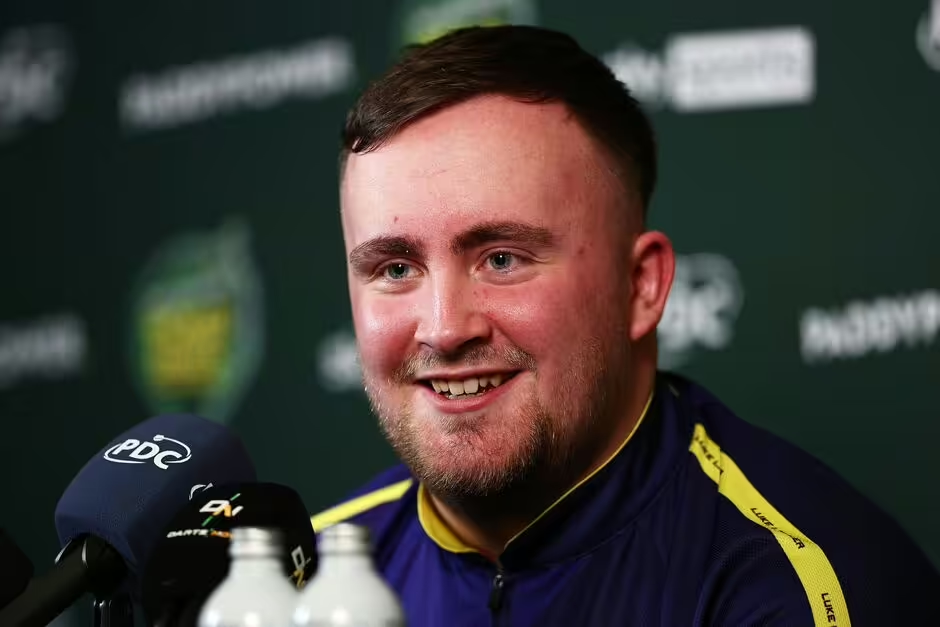
In the high-pressure arena of professional darts, where every leg can swing on a single dart and emotions run raw under the bright lights, even the sport’s brightest young star is not immune to moments of human frailty. Teenage sensation **Luke Littler**, the 19-year-old world champion whose explosive talent has captivated millions, recently found himself at the centre of a tense on-stage clash with rising Dutch rival **Gian van Veen**. What began as a fiercely contested Premier League Darts quarter-final in Manchester quickly escalated in the deciding leg, sparking a heated exchange that left both players visibly agitated and the crowd buzzing with controversy.
The incident unfolded during a thrilling rematch of January’s World Darts Championship final. With the match tied at 5-5 and the tension palpable, Van Veen missed a crucial match dart. Littler, sensing an opening in front of a partisan home crowd, reacted with visible celebration. Van Veen responded with a disapproving glare, prompting Littler to gesture angrily and later make a ‘cry baby’ motion toward the spectators as boos rained down. The brief but fiery confrontation — marked by sharp words, frustrated body language, and a charged atmosphere — overshadowed what had been a high-quality display of darts. Though the match continued without further physical disruption, with Van Veen eventually prevailing 6-5, the aftermath ignited widespread debate across the darts community about sportsmanship, respect, and the intense pressures of elite competition.
Days after the clash, Littler stepped forward with a sincere and heartfelt public apology, demonstrating the maturity that has become a hallmark of his rapid ascent despite his tender age. Taking to social media and public statements, the world number one owned his role in the escalation without hesitation. “I want to sincerely apologize to my opponent, the fans, and everyone involved in the event,” he stated. “My behavior fell short of the standards I set for myself, and I deeply regret any harm or disappointment I may have caused. I will use this experience as an opportunity to grow and learn.”
His words resonated deeply, striking a chord with fans who have watched him navigate the whirlwind of overnight fame, record-breaking achievements, and relentless expectations. Littler’s apology highlighted a young man aware of the spotlight’s glare — one who understands that while passion fuels greatness on the oche, it must be tempered with accountability off it.
Van Veen, for his part, responded with equal candour and self-reflection. The 23-year-old Dutch talent, who has emerged as one of Littler’s most formidable rivals in recent months, admitted feeling profound remorse over his own reactions. “I take full responsibility for my reactions and the way I handled the pressure in that moment,” he said. “It was not representative of the respect I have for Luke as a competitor or the spirit of the game we both love.” Describing himself as “deeply ashamed,” Van Veen stressed his commitment to the values of fair play, acknowledging that high-stakes environments can cause emotions to flare but should never eclipse mutual respect between professionals.
The dual apologies have been widely praised as a mature, constructive response in a sport known for its fiery personalities and passionate rivalries. Social media platforms lit up with messages of support, with many fans commending both players for stepping up, taking ownership, and choosing growth over deflection. Commentators noted that such incidents, while regrettable, humanise the athletes and offer valuable lessons in emotional regulation under extreme duress.
For Littler, already a household name after claiming back-to-back world titles and dominating headlines since bursting onto the scene as a teenager, the episode served as a potent reminder of the challenges that accompany success. The constant scrutiny, the weight of expectations from sponsors and supporters, and the emotional toll of nightly battles against seasoned pros can test even the most gifted competitors. In the heat of battle, split-second frustrations — a missed dart, a perceived slight, or crowd noise — can trigger reactions that players later wish they could rewind.
Sports psychologists have weighed in on the broader context, explaining that moments like this often stem from the unique demands of darts. The sport requires laser-like focus for hours, with minimal physical outlet for adrenaline, making mental resilience as critical as throwing accuracy. One expert observed that young athletes in high-pressure settings benefit greatly from support systems that help process such incidents while safeguarding their well-being and integrity.
Veteran voices in the darts world echoed this perspective with encouragement. Former world champion Phil Taylor reflected on the importance of handling regret: “Everyone has moments they regret, especially in the heat of competition. What matters is how you handle it afterward, and I think both players have shown real character in their responses.” Fellow professional Fallon Sherrock added a note of solidarity: “We all make mistakes, but it takes real courage to own up and move forward. Luke has a bright future ahead, and this will only make him stronger.”
The clash has also prompted wider reflection within the darts community about its culture. The sport thrives on drama, larger-than-life personalities, and intense rivalries that fuel its popularity. Yet incidents like this underscore the delicate balance required: celebrating passion and entertainment while upholding respect and professionalism on stage. The PDC and players alike continue to emphasise that while crowds bring energy, the core of the game lies in fair competition and sportsmanship.
As the Premier League and Pro Tour progress, both Littler and Van Veen appear determined to channel the experience into positive energy on the board. Littler, ever resilient, has vowed to move forward constructively. “We all have moments where we fall short, but what matters is how we move forward,” he affirmed. “I’m committed to being better — for myself, for my opponents, and for the fans who support us.”
The tight-knit darts fraternity has largely rallied around the pair, reinforcing that true character is revealed not in perfection but in the ability to acknowledge errors, apologise sincerely, and emerge stronger. With mutual respect reaffirmed through their public statements, the hope is that this chapter strengthens rather than divides the sport. It serves as a timely reminder that behind every arrow lies a human story — one of ambition, pressure, vulnerability, and the capacity for growth.
In an era where darts enjoys unprecedented global appeal, moments of reconciliation like this ultimately enhance its appeal. They show that even superstars like Littler are still learning and evolving, much like the fans who cheer them on. As the 2026 season unfolds with more high-stakes encounters, the focus returns to the thrilling skill that defines the game, enriched by the integrity both players have demonstrated in its wake. The oche awaits, and with it, fresh opportunities for redemption through precision, composure, and the relentless pursuit of excellence.
Leave a Reply