
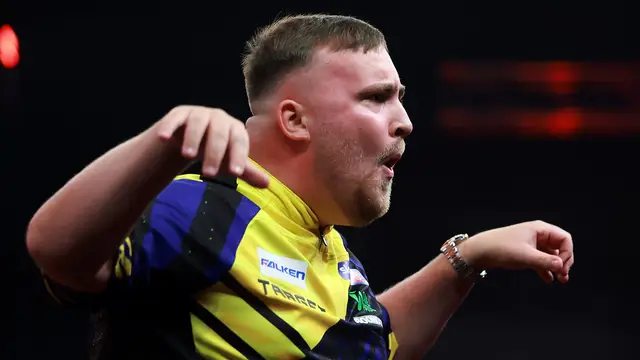
Luke Littler has found himself at the centre of another heated darts debate, but this time a fellow professional has offered him a rather different way of dealing with hostile crowds.
After a turbulent weekend in Amsterdam, World Series of Darts Finals champion Ross Smith suggested that Littler’s reactions to the crowd could actually be creating more problems for the world number one.
And while there is no question that darts crowds are passionate, the events in Amsterdam showed just how complicated the relationship between Littler and some sections of the audience has become.
The Amsterdam Problem
Littler arrived at the World Series of Darts Finals with an extraordinary opportunity. He was attempting to become the first player to complete a clean sweep of all 11 PDC major titles in a single calendar year.
That dream ultimately disappeared when Jonny Clayton beat him 10-4 in the quarter-finals.
But strangely, the defeat itself was not the biggest talking point.
Instead, much of the attention centred on the reception Littler received from the Dutch crowd. He was booed and whistled during his opening win over home favourite Danny Noppert before facing further hostility against Nathan Aspinall.
That second match became particularly uncomfortable when referee Charlie Corstorphine stopped play and intervened over the whistling from spectators.
Littler eventually won that contest 10-9, but his frustration with the atmosphere was obvious.
Earlier in the tournament, after beating Noppert 6-4, Littler had already warned that he could stop travelling to the Netherlands if the treatment continued.
“If the Dutch stay like this, then I’m not going to do any Euro Tours over there.”
He later followed through by withdrawing from Players Championship 29 and 30 in Den Bosch and cancelling his entry into the Dutch Darts Championship in Maastricht.
So this was no longer simply a player complaining about a noisy crowd.
It had started to affect Littler’s tournament schedule.
Why Ross Smith Thinks Littler Could Change His Approach
Smith, who went on to win the World Series of Darts Finals after beating Gerwyn Price 11-5, offered a different perspective.
The 37-year-old did not claim to know exactly what Littler experienced because he was not on stage during those matches. But he suggested that reacting aggressively to supporters can sometimes encourage them to continue.
“I think if you’re aggressive towards the crowd and you’re letting them know that it’s affecting you and you’re making them unhappy, it’s not a good thing,” Smith said.
Smith explained that he has tried a different tactic himself.
“I tried to, with Gian [van Veen], I had more banter with them, you know what I mean? Just like thumbs up to them, but smiling, not in an aggressive way and they sort of laugh with you, it’s not a problem.”
His broader point was simple: if a player appears angry or irritated, some supporters may see that as an invitation to push even harder.
“I think it’s how you can react on stage, if you’re aggressive towards them, it’s going to create problems for you,” Smith added.
However, Smith also acknowledged an important caveat.
“But like I said, I can’t really comment on Luke because I wasn’t playing in the games with Luke and I don’t know what he actually went through, but they can be brutal at times.”
That final sentence matters.
The debate is not simply about whether Littler should ignore fans. Some of the behaviour he has faced has involved whistling during play, which players and commentators have repeatedly identified as particularly distracting.
Stephen Bunting Wants Punishments
Stephen Bunting has also weighed into the debate, and his suggestion was considerably more direct.
Speaking after the Amsterdam controversy, Bunting said he believed the sport may need formal consequences for spectators who repeatedly cross the line.
“Punishments need to be brought in, maybe. To give it some sort of stop. Until that happens, it’ll keep happening.”
Bunting explained why whistling bothers players so much.
“It’s a horrible noise to hear when you’re trying to concentrate.”
That distinction is important because darts is unlike many other sports.
A footballer can potentially ignore a hostile crowd while sprinting around a pitch. A darts player has to stand still and execute an incredibly precise throw while surrounded by thousands of spectators.
A tiny distraction can change a leg.
Littler’s History With Hostile Crowds
This is also not the first time Littler has found himself in this situation.
His relationship with certain crowds became more complicated during the 2025 World Championship when supporters backed Rob Cross during their quarter-final.
After winning 4-2, Littler responded directly to the boos.
“I’m not bothered [by the booing]. Really not bothered. You guys pay for tickets, and you pay for my prize money so thanks for booing me,” Littler said at the time.
“No one wanted me to win, but I proved them wrong yet again.”
There was then the controversial Premier League clash with Dutchman Gian van Veen in April 2026.
Van Veen accused Littler of celebrating after he missed a match dart, while Littler disputed the interpretation of what happened. Littler later made a “cry baby” gesture during the dramatic conclusion, with Van Veen eventually winning 6-5.
That history helps explain why some Dutch crowds may have been particularly hostile.
It also explains why Ross Smith believes Littler might benefit from changing how he responds.
A Difficult Balance for Littler
There is an interesting contradiction here.
Littler’s personality is part of what has made him such a huge attraction. He interacts with crowds, celebrates passionately and clearly enjoys the theatre surrounding major darts matches.
PDC chief executive Matt Porter previously said Littler had often “thrived” on crowd hostility, while also suggesting that he might eventually need a different approach if he wanted to change the atmosphere around him.
But there is a difference between playing along with a noisy audience and allowing repeated whistling or jeering to interfere with concentration.
That is where the debate becomes much harder.
Littler cannot control whether an entire arena decides to support his opponent. He can control his response, but expecting a player to simply absorb every form of crowd behaviour without reacting is easier said than done.
And the numbers show how extraordinary his season has already been. His 2026 campaign included six major titles before Clayton ended his World Series bid.
At only 19, Littler is already experiencing something many established professionals spent their entire careers building towards: becoming the player everyone wants to beat.
That naturally brings pressure from opponents and spectators.
What Happens Next?
The most interesting part of this story may be what Littler does with the criticism.
Smith’s advice is not necessarily a demand that Littler should accept everything thrown at him. It is more about removing the reaction that can give hostile supporters exactly what they want.
Bunting, meanwhile, believes the sport itself has a responsibility to deal with behaviour that crosses the line.
Both arguments can exist at the same time.
Littler can work on controlling his response, while the PDC continues addressing unacceptable conduct from spectators.
For now, the Amsterdam weekend has added another chapter to one of the most unusual crowd relationships in modern darts.
Littler remains the sport’s biggest young star, but he is discovering that being the man everyone wants to beat also means becoming the man some fans desperately want to see lose.
Whether he chooses to embrace that role, ignore it or change how he responds could become one of the most intriguing storylines of his career.
And after everything that happened in Amsterdam, fans will certainly be watching the crowd as closely as they watch Littler’s next visit to the oche.