
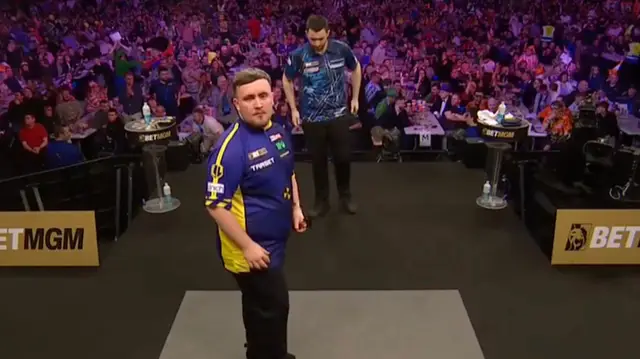
The bright lights of the OVO Hydro illuminated a packed arena as thousands of fans poured in for night two of the Premier League Darts, creating the kind of electric atmosphere the sport has become famous for. Anticipation built steadily throughout the evening, but all eyes were fixed on the final showdown between teenage sensation Luke Littler and world number one Luke Humphries. It was a clash that promised elite-level precision, mental toughness, and high drama—and in many ways, it delivered exactly that. Yet the night would ultimately be remembered for more than just the darts thrown on stage.
From the opening leg, both players demonstrated why they sit among the very best in the world. Littler, still only 18, played with the confidence and fearless scoring power that has defined his meteoric rise, while Humphries brought his trademark composure and clinical finishing to keep the contest finely balanced. The match swung back and forth, each player responding to the other’s brilliance with moments of their own. It was darts of the highest quality, the kind that keeps fans on the edge of their seats.
However, as the tension built, an unwelcome factor began to creep into the contest. Sections of the crowd started whistling—loud, sharp, and deliberately timed to coincide with players stepping up to throw. What should have been a wall of supportive noise quickly became something far more disruptive. Rather than adding to the spectacle, it interrupted the rhythm of the game, particularly affecting Humphries during key moments.
Darts, unlike many other sports, relies heavily on rhythm, focus, and repetition. Players operate in a finely tuned mental space where even the slightest distraction can have a significant impact. The whistling cut through that focus, creating an uneven playing field that frustrated both competitors and drew immediate attention from those watching.
Despite the growing noise, the match continued to deliver thrilling moments. Littler fired in heavy scoring visits, while Humphries responded with clutch finishes that kept him within touching distance. The contest eventually reached a deciding leg at 5-5, a fitting climax for such a high-quality encounter. Holding his nerve under pressure, Littler produced a composed final leg to seal a 6-5 victory, adding another impressive win to his rapidly growing résumé.
Yet even in victory, the conversation quickly shifted away from the result and toward the crowd’s behavior. Littler himself addressed the issue candidly after the match, acknowledging how the whistling had influenced key moments. He pointed out that some of the noise was specifically targeted when Humphries was throwing, highlighting the unsporting nature of the disruption.
The situation became even more complicated when referee Kirk Bevins attempted to intervene. Using the microphone, Bevins urged the crowd to quiet down and respect the players. In theory, it was the right call—officials have a responsibility to protect the integrity of the match. In practice, however, the intervention appeared to have the opposite effect. Rather than calming the situation, it seemed to provoke an even louder reaction from certain sections of the audience.
Littler later reflected on that moment, suggesting that the attempt to silence the crowd may have unintentionally escalated the disruption. He even linked it to a turning point in the match, where he missed crucial doubles and briefly fell behind at 5-4. It was a rare glimpse into how even the smallest external factors can influence outcomes at the highest level.
Importantly, Littler did not simply complain—he offered a balanced perspective. He acknowledged that officials sometimes need to step in but suggested that knowing when not to act can be just as important. His comments revealed a maturity beyond his years, reinforcing why he has adapted so quickly to the pressures of professional darts.
The whistling was not limited to the final. Earlier in the evening, Gerwyn Price had also been affected during his match against Humphries. In a moment that captured the frustration felt by players, Price even responded by whistling back at the crowd, turning the disruption into a brief act of defiance. While it drew a reaction from the audience, it also underlined how widespread the issue had become throughout the night.
For Humphries, the challenge was particularly difficult. As the world number one, he is used to pressure, but the added layer of targeted noise created an unusual test of concentration. Known for his calm demeanor, he continued to compete at a high level, but the interruptions undeniably made an already demanding contest even tougher.
The reaction from the broadcast team was swift and strong. A presenter from Sky Sports openly criticized the behavior, describing it as unacceptable and harmful to the sport. The comments reflected a wider sentiment among fans and pundits who felt the line between passionate support and deliberate distraction had been crossed.
Darts has long thrived on its unique atmosphere. Crowds are encouraged to sing, chant, and celebrate, creating a party-like environment that sets it apart from more traditional sports. That energy is a huge part of its appeal, drawing in new audiences and making events feel like major spectacles. But nights like this highlight the delicate balance required to maintain that atmosphere without undermining the competition itself.
This is not the first time such concerns have been raised. In recent years, several top players—including Michael Smith—have spoken out about disruptive crowd behavior, particularly in matches involving Littler. As one of the sport’s biggest draws, Littler often attracts intense reactions, both positive and negative. Managing those reactions has become an ongoing challenge for organizers.
The Professional Darts Corporation has previously addressed the issue, emphasizing the importance of respect and sportsmanship. Following the events in Glasgow, discussions have once again intensified حول how best to handle such situations. Suggestions range from clearer pre-match announcements to stricter enforcement inside venues, all aimed at preserving fairness without dampening the atmosphere.
For Littler, the night was another statement performance. His ability to recover from going behind and close out the match under pressure showcased the mental strength that defines champions. Each victory adds to the growing belief that he is not just a rising star, but a genuine contender for major titles.
Humphries, meanwhile, will take positives despite the defeat. His consistency and resilience remain among the best in the world, and he is certain to remain a dominant force as the season progresses. Matches like this, even when disrupted, only add to the developing rivalry between the two players.
In the broader context, the Glasgow night served as both a celebration and a warning. The quality of darts on display was exceptional, a reminder of why the sport continues to grow globally. But the crowd controversy showed how quickly the focus can shift away from the action if boundaries are not respected.
As the Premier League roadshow moves on to its next destinations, players, officials, and fans alike will hope for a return to a more balanced atmosphere—one where passion enhances the spectacle rather than detracts from it. The responsibility ultimately lies with everyone involved. Players must perform, officials must manage, and fans must support in a way that respects the competition.
The final in Glasgow should have been remembered solely for its drama and brilliance. In many ways, it still will be—a gripping contest between two outstanding talents. But it also leaves behind an important conversation about the role of the crowd in modern darts. If that conversation leads to positive change, then perhaps the disruption will not have been entirely in vain.
Leave a Reply