
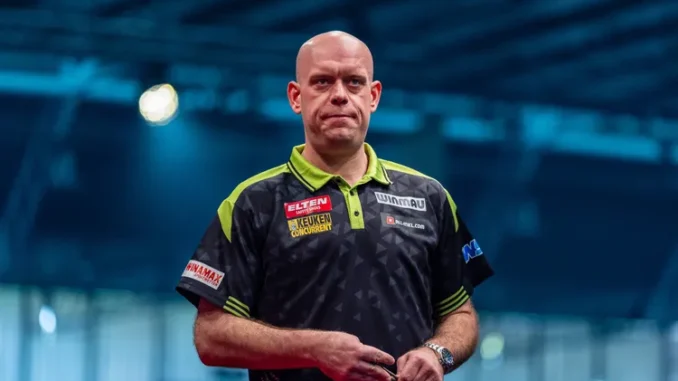
Wayne Mardle has delivered a frank and detailed assessment of Michael van Gerwen’s current standing in the game, suggesting that the Dutch superstar’s biggest challenge is no longer his peak level, but what happens when he is not playing at his very best.
The Sky Sports pundit, who also enjoyed a successful professional darts career, believes that while Van Gerwen remains one of the most dangerous and accomplished players in the sport, there is a growing issue around consistency in his so-called B-game. In elite darts, the difference between A-game and B-game can be the difference between lifting trophies and early exits, and Mardle feels that gap is becoming more significant for the three-time world champion.
“My concern or maybe his concern for himself is his B-game doesn’t win,” Mardle said, summing up his view that Van Gerwen is increasingly reliant on top-level performances to get over the line in matches.
The comment reflects a broader discussion in darts about how the modern game has evolved and why consistency is now more important than ever. At the highest level, players are not only judged on their ability to produce brilliance, but also on whether they can still find ways to win when their rhythm is not perfect.
Van Gerwen, for over a decade, has been one of the defining figures in world darts. His dominance in the 2010s saw him win multiple World Championships, Premier League titles, and a long list of major ranking events. At his peak, he was feared for his relentless scoring power, rapid playing rhythm, and an ability to blow opponents away before they could settle into matches.
During those years, even when Van Gerwen was not at his absolute peak, he often found a way to win. His B-game, while not as explosive as his best level, was still strong enough to outclass most opponents. That reliability was a key part of what made him so dominant for such a long period.
However, Mardle’s assessment suggests that this aspect of his game is no longer as dependable against the current crop of elite players. The standard in professional darts has risen significantly, with more players capable of producing high averages and sustained pressure throughout matches. As a result, any dip in performance is now more likely to be punished.
Van Gerwen is still widely regarded as one of the greatest players in darts history. His achievements place him among the sport’s all-time elite, and he continues to compete at the highest level. Even in recent seasons, he has reached the latter stages of major tournaments and remains a constant threat to win titles.
But Mardle’s point is not about Van Gerwen’s peak ability. It is about sustainability. In modern darts, tournaments are long, formats are demanding, and players are required to maintain high standards across multiple rounds. A single poor session or a drop in average can now cost matches that previously might have been routine victories for a player of Van Gerwen’s calibre.
The Dutchman’s A-game is still among the best in the sport. When everything clicks, he remains capable of producing destructive scoring runs and clinical finishing that very few players can match. The concern, as highlighted by Mardle, is that those performances are becoming more necessary for him to win matches, rather than being a bonus.
In earlier stages of his career, Van Gerwen’s B-game was often still strong enough to dominate opponents. He could win matches without being at his absolute best because his baseline level was higher than most of his rivals. That margin, however, has narrowed as the sport has developed.
Modern darts has seen a rise in depth across the professional circuit. More players are averaging high numbers, finishing efficiently, and applying pressure consistently. This means that even small drops in performance can now swing matches against top opponents.
Mardle’s analysis highlights how important adaptability has become. Players are no longer only judged on their peak performances but on how they handle matches when they are not flowing perfectly. The ability to grind out wins, stay competitive under pressure, and find ways to recover mid-match has become essential.
For Van Gerwen, this raises questions about how often he can still rely on his natural talent alone to carry him through difficult matches. While his experience and competitive mindset remain strong, the physical and mental demands of maintaining elite performance over long periods are increasing.
“There’s no B-game,” Mardle has suggested in broader discussions about elite consistency, reinforcing the idea that at the very top level, players must find ways to win even when not playing their best darts.
That observation reflects the reality of today’s professional game. With tighter competition and higher standards across the board, the gap between players has reduced significantly. Matches are often decided by small margins, and those margins are frequently influenced by who can maintain a solid level of performance when things are not going smoothly.
Van Gerwen’s career, however, remains one of extraordinary success. His dominance across multiple years helped redefine what was possible in professional darts. His ability to win major titles repeatedly and maintain a presence at the top of the rankings for such a long period is a testament to his skill and mentality.
Even now, despite the scrutiny, he remains one of the most feared competitors in the game. Opponents know that if he finds his rhythm, he can still take control of matches in a matter of legs. That reputation alone continues to make him a major force in every tournament he enters.
But as Mardle points out, the sport has changed. Players can no longer rely solely on reputation or occasional bursts of brilliance. Sustained performance across entire matches and tournaments is now essential.
The debate around Van Gerwen’s current form is therefore not about decline in absolute terms, but about how the modern game has shifted around him. What once might have been enough to win comfortably is now being tested by a deeper and more competitive field.
Ultimately, Mardle’s comments reflect a key truth in elite sport: success is not only about how good you are at your best, but how often you can perform close to that level when conditions are not ideal. For Van Gerwen, that challenge now sits at the centre of discussions about his ongoing place at the very top of darts.
Leave a Reply