
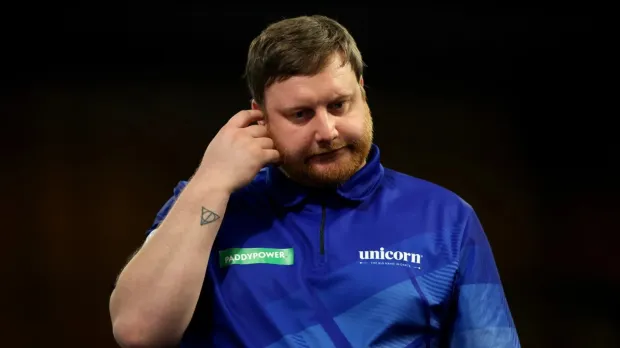
In the ruthless world of professional darts, glory and despair can sit just one bad night apart. One moment a player is walking out under the bright lights of Alexandra Palace with dreams of lifting the Sid Waddell Trophy, and the next, they are questioning everything—including whether they still belong in the sport at all. That harsh reality has now hit another darts star, who was reportedly offered his old job after a nightmare World Championship campaign left his career at a crossroads.
The story centres around Cameron Menzies, a player whose journey has swung between breakthrough moments and crushing setbacks. After committing fully to darts following strong performances and a rise through the rankings, expectations naturally grew. But the World Darts Championship can be unforgiving, and when things go wrong there, they go very wrong. A disappointing early exit at the biggest stage of them all, combined with a dip in form and personal frustration, led to an unexpected twist: the return of a job offer from his former workplace.
At first glance, it sounds almost unbelievable—how can a professional athlete be pulled back into an old 9-to-5 after competing on one of sport’s biggest stages? But in darts, the reality is often different from the glamorous image fans see on TV. Unlike football or tennis, not every player earns life-changing money. Many sit in a strange middle ground where they are professionals in name, but still need backup plans when results don’t come.
Menzies’ situation reflects that fragile balance. After a tough run at the World Championship, where pressure, expectations, and form all collided at the worst possible time, he reportedly found himself reconsidering his future. There were even moments where he revisited old career options, including plumbing work, something he had previously stepped away from to pursue darts full-time.
From one perspective, this is a story of setback. A player chasing ambition, only to be reminded that elite sport offers no guarantees. From another perspective, it is a story of resilience and realism. Because instead of collapsing completely under pressure, Menzies appears to have faced a very human question: what happens when your dream doesn’t go to plan?
And that is where opinions in the darts world begin to split.
Some fans see stories like this as a warning sign. They argue that the sport is becoming increasingly demanding, with younger players entering the system earlier, pushing standards higher and leaving less room for inconsistency. In that environment, a single poor championship run can feel like it changes everything. For them, a darts star returning to an old job is a sign that the sport still lacks the financial stability and support structure seen in bigger global sports.
Others, however, see it differently. They argue that having a fallback job is not a failure—it is actually smart. In a sport where form can disappear overnight and confidence is everything, knowing you have another path can take pressure off players. In that sense, Menzies’ situation is not embarrassing, but grounding. It reflects a working-class reality that still defines much of darts: many players are not far removed from ordinary jobs, and many still maintain ties to them.
Personally, the most interesting part of this story is not the job offer itself, but what it says about pressure in modern darts. The World Championship is no longer just a tournament—it is a career-defining stage. One good run can change a life. One bad night can trigger doubts that ripple far beyond the oche. That kind of pressure is brutal, especially for players who are still trying to establish themselves.
It is also worth pointing out that setbacks like this are not new in darts history. The sport is full of players who have dipped in and out of form, returned to day jobs, or rebuilt their careers from scratch. What feels like a “nightmare” today can often become a turning point tomorrow. In fact, many successful professionals have spoken about moments where they nearly walked away before finding form again.
That is why this situation should not be viewed as the end of the road. If anything, it might be a reset point. The fact that Menzies has been linked with improved mental approaches and has been working on his focus suggests that the story is still developing. Darts is a sport where confidence can return quickly—sometimes from just one good tournament or one big win on stage.
Still, the uncomfortable truth remains: not every darts story is a fairy tale. For every player lifting trophies, there are others fighting to stay on tour, balancing finances, and wondering if they made the right decision leaving steady jobs behind. That contrast is what makes the sport both exciting and brutally honest.
In my view, stories like this actually make darts more real, not less. Fans often only see the highlight reels—the nine-darters, the walk-ons, the packed arenas. But behind that is a world where players are constantly fighting for consistency, income, and identity. The idea that a professional darts player could be offered their old job after a World Championship nightmare is not just a headline—it is a reminder that the gap between success and struggle in this sport is extremely thin.
Whether this becomes a setback or a comeback story will depend on what happens next. Darts has a way of rewriting narratives quickly. One strong run on the Pro Tour, one deep run in a major, or one surprise win on TV, and everything can change again.
For now, though, it stands as one of those moments that exposes the raw edge of professional darts: behind the glamour, the trophies, and the roaring crowds, there is always the possibility of going back to where it all started.
And sometimes, that is exactly where the next chapter begins.