
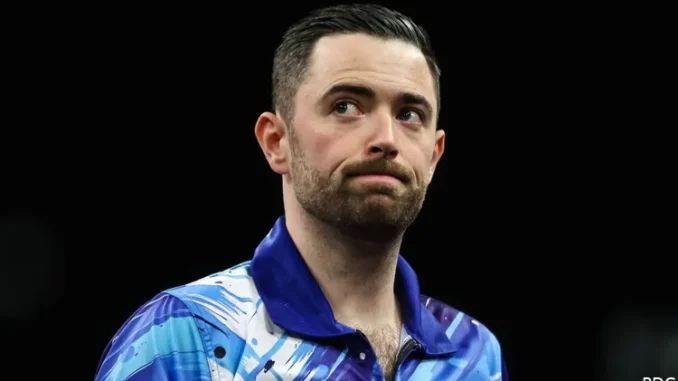
Former world champion Mark Webster has sparked discussion in the darts world after offering a blunt and honest assessment of Luke Humphries, questioning whether the world number one may have briefly lost belief in his ability during a concerning dip in form.
Humphries, widely known as “Cool Hand Luke,” has established himself as one of the most consistent and dominant figures in modern darts. His rise to the top has been built on calmness under pressure, exceptional scoring power, and a finishing game that has delivered him multiple major titles. He is regarded as one of the most complete players in the sport, capable of beating anyone on his day.
However, recent performances have not reflected that elite status, and his form has become a growing talking point. While he remains one of the strongest competitors on the circuit, there has been a noticeable drop in his usual standards, particularly in key moments where he would normally thrive. That inconsistency has led to questions about whether his confidence has been affected.
Webster, who now works closely as an analyst of the game, did not hide his concerns when reviewing Humphries’ recent displays. He admitted that one performance in particular stood out for all the wrong reasons, not because of technical flaws alone, but because of what he perceived as a lack of conviction.
“I actually questioned whether he thought he could win last week,” Webster said, highlighting just how unusual the situation felt for someone of Humphries’ calibre.
That observation cuts to the heart of what makes Humphries so effective when he is at his best. His game is built not just on ability, but on belief. When he steps onto the stage with confidence, he is capable of overwhelming opponents with relentless scoring and precise finishing. Any sign that this belief may be wavering naturally raises concern.
The match that prompted Webster’s comments saw Humphries struggle to impose himself from the outset. He failed to find his rhythm early, and as the game progressed, opportunities to turn things around slipped away. What stood out most was not just the result, but the manner of the performance, with missed chances and visible frustration becoming more frequent as the match went on.
One of the key issues was his finishing. Normally one of the most reliable aspects of his game, his doubles were unusually inconsistent. In crucial moments, he failed to take advantage of openings, allowing his opponent to gain control. For a player of his standard, those missed opportunities were particularly uncharacteristic.
Webster pointed out that it was not simply a case of bad luck or an off night. Instead, he suggested that Humphries appeared hesitant at key moments, as if second-guessing himself in situations where he would normally be decisive. That hesitation, even if only small, can have a significant impact in a sport where margins are razor thin.
The Premier League environment adds further pressure to such moments. With weekly matches against the best players in the world, there is little room to recover from a poor performance. Momentum is crucial, and once it is lost, it can be difficult to regain. Humphries has found himself struggling to build that momentum consistently throughout the campaign.
Despite his status as world number one, he has endured a run of results that fall short of his usual expectations. Early exits and missed opportunities have left him chasing form rather than controlling events, a position that is unfamiliar for a player who has spent much of his career dictating matches.
Webster acknowledged that while concerns exist, it is important to remember the quality Humphries possesses. Players of his level do not lose ability overnight. Instead, dips in form are often linked to confidence, rhythm, or minor technical adjustments that can quickly be corrected.
In darts, confidence plays a crucial role. When a player is in form, everything feels natural. Scoring flows effortlessly, finishing is instinctive, and pressure situations are handled with ease. When confidence dips, even slightly, those same situations become more difficult. Doubles feel tighter, decisions take longer, and the natural flow of the game can be disrupted.
That appears to be the area Webster is most focused on. His comments suggest that Humphries may be experiencing a temporary disconnect between his ability and his belief in it. When those two elements are not aligned, even the best players in the world can struggle to perform at their peak.
External pressure may also be contributing to the situation. As one of the leading figures in the sport, Humphries is under constant scrutiny. Every match is analysed, every result dissected, and expectations remain high regardless of recent form. That level of attention can weigh heavily, particularly during a difficult run.
The competitive landscape has also intensified. With other top players performing strongly and new talents emerging, maintaining dominance requires constant excellence. There is no opportunity to ease off, and any drop in performance is quickly punished.
Despite these challenges, there remains a strong belief that Humphries can recover his best form. His track record demonstrates his ability to respond under pressure, and his technical foundation remains among the strongest in the game. Players of his quality rarely remain in a slump for long.
Webster’s comments should therefore be seen less as criticism and more as observation. They reflect surprise at seeing a player of Humphries’ calibre look slightly out of rhythm, rather than doubt over his long-term ability. In many ways, it highlights just how high expectations have become for him.
The path forward is clear. A strong performance, or a deep run in an upcoming event, could quickly restore confidence. In darts, momentum can shift rapidly, and one positive result often leads to another. For Humphries, rediscovering that winning feeling will be key.
There is also a mental aspect to consider. Rebuilding confidence is often about simplifying the game—trusting instinct, reducing hesitation, and allowing natural ability to take over. Once that balance is restored, performance levels usually follow.
For fans and observers, this period adds an interesting layer to Humphries’ career. It is a reminder that even the most successful players experience challenges, and that maintaining success at the highest level requires constant adaptation.
Ultimately, Webster’s remarks highlight a broader truth about elite sport: talent alone is not enough. Belief, confidence, and mental strength are just as important. For Luke Humphries, the current challenge is not about rediscovering ability, but about fully trusting it once again.
If he can do that, there is every reason to believe he will return to the dominant form that has defined his career. And when he does, the questions about his belief will quickly fade, replaced instead by the familiar sight of a player once again controlling matches with authority and precision.
Leave a Reply