
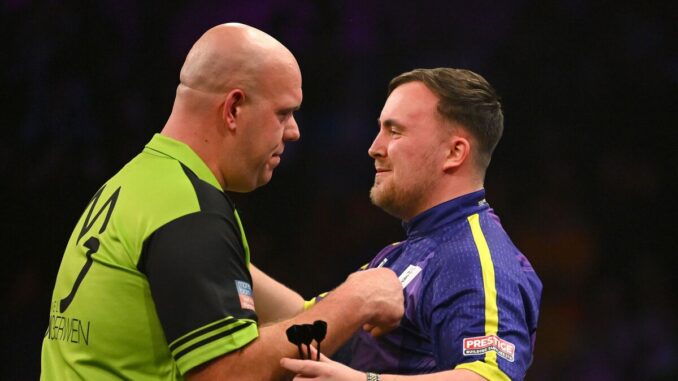
The incredible rise of Luke Littler has brought more than just trophies, big-stage performances, and headlines about his talent. It has also introduced a series of light-hearted moments that reveal the personality behind the teenage sensation. One of the most talked-about came when Michael van Gerwen gave him a blunt, two-word nickname that quickly caught the attention of fans across the darts world.
Littler’s breakthrough has been nothing short of remarkable. Still in his teens, he has stepped onto some of the biggest stages in darts and played with a level of confidence and composure that many seasoned professionals struggle to maintain. His rapid scoring, fearless finishing, and calm demeanor have made him a standout figure, drawing admiration from both fans and fellow players. However, as his reputation has grown, so too has the spotlight on his personality and life away from the oche.
That spotlight has naturally led to more interactions with established stars, none bigger than Van Gerwen. The Dutchman, widely regarded as one of the greatest darts players of his generation, has dominated the sport for years with his relentless consistency and winning mentality. When Littler burst onto the scene, many were curious to see how the experienced champion would react to the arrival of such a young and fearless challenger.
Their meetings on stage have already delivered high-quality contests, with Littler showing that he can compete with the very best. But away from the intensity of competition, their relationship has revealed a more relaxed and humorous side. It was during one such moment that Van Gerwen shared the nickname he had given to the young English star — a nickname that was as direct as it was memorable.
“I call him kebab boy,” Van Gerwen admitted, a comment that immediately stood out because of its simplicity and bluntness. The nickname was inspired by Littler’s well-known fondness for a particular post-match treat. The teenager has openly spoken about enjoying a kebab after games, a detail that quickly became part of his public image as his popularity soared.
Rather than using Littler’s official nickname, “The Nuke,” which reflects his explosive scoring power, Van Gerwen chose something far more personal. The result was a label that felt less like a branding exercise and more like the kind of playful teasing shared between competitors who have grown familiar with each other.
Despite how it might sound at first, there was no sense of negativity behind the remark. In fact, the tone suggested the opposite. Van Gerwen’s comment came across as light-hearted banter, a reflection of the camaraderie that often exists behind the scenes in professional darts. It also hinted at a level of respect, as players tend to reserve that kind of joking familiarity for those they see as genuine peers.
For fans, the story quickly became a talking point. It added another layer to Littler’s already fascinating journey, showing that even as he competes at the highest level, he remains relatable. The idea of a teenage sports star celebrating victories with something as ordinary as a takeaway meal struck a chord with many, reinforcing his down-to-earth image.
Nicknames have always played a big role in darts culture. From dramatic titles to humorous labels, they help define players and make them more memorable to audiences. In Littler’s case, “The Nuke” has already become synonymous with his playing style. But “kebab boy,” while unofficial, offered a glimpse into how he is viewed within the inner circle of professionals.
The exchange also highlighted the unique atmosphere within the sport. While darts is highly competitive, it is also known for its sense of personality and connection between players. Banter is common, and moments like this help humanize athletes who might otherwise seem untouchable during intense matches.
For Littler, handling such moments has been part of adjusting to life in the spotlight. His rise has been rapid, bringing with it increased media attention, public recognition, and constant scrutiny. Yet throughout it all, he has maintained a calm and grounded approach, rarely appearing overwhelmed by the attention surrounding him.
His ability to take the nickname in stride is another example of that maturity. Rather than reacting defensively, he has embraced the lighter side of the situation, understanding that it comes with the territory of being in the public eye. That attitude has only strengthened his connection with fans, who appreciate both his talent and his authenticity.
The relationship between Littler and Van Gerwen continues to be one of the most intriguing aspects of modern darts. On one hand, it represents a clash between experience and youth — a seasoned champion against a rising prodigy. On the other, it shows how competition and camaraderie can coexist, creating a dynamic that benefits both players and the sport as a whole.
Van Gerwen’s willingness to engage in playful banter also suggests that he recognizes Littler as a serious competitor. For a player who has achieved so much, acknowledging a newcomer in this way is significant. It signals that Littler is no longer just a promising talent, but a genuine contender capable of challenging the very best.
As Littler’s career continues to develop, stories like this will likely remain part of his narrative. They add depth to his journey, showing that his impact goes beyond results and statistics. He is not just winning matches; he is becoming a personality within the sport, someone who attracts attention both on and off the stage.
Ultimately, the “kebab boy” nickname is more than just a humorous anecdote. It reflects the culture of darts, where individuality and character are celebrated alongside skill. It also highlights the way Littler has quickly integrated into the highest level of the game, earning recognition from one of its biggest stars.
With his talent, composure, and relatable personality, Littler’s story is still in its early chapters. If his rise so far is anything to go by, there will be many more memorable moments to come — and perhaps a few more nicknames along the way.
Leave a Reply