
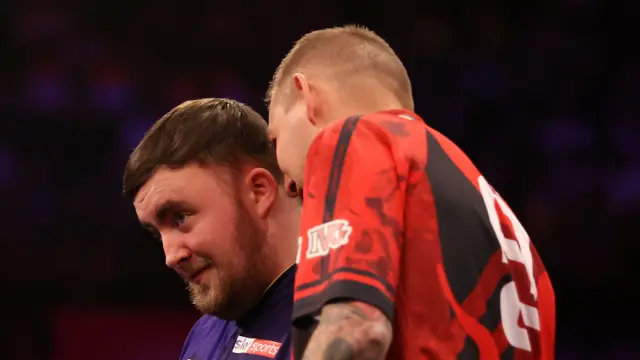
In the fiercely competitive world of professional darts, where rivalries burn brightly on the oche and personalities clash under intense scrutiny, a candid admission from one of the sport’s most respected figures has shone a light on the challenges facing its brightest young star. **Nathan Aspinall**, a former UK Open champion and fan favourite known for his no-nonsense approach, has opened up about the frosty reception that teenage sensation **Luke Littler** has reportedly received from some of his fellow professionals on the PDC tour.
Littler, who exploded onto the scene as a 16-year-old prodigy and went on to become the youngest world champion in darts history at just 17 years and 347 days old in early 2025, has captivated global audiences with his fearless scoring, clutch finishing, and remarkable composure beyond his years. Dubbed “The Nuke,” the Warrington-born talent has shattered records, claimed major titles, and injected fresh energy into the sport. His meteoric rise has drawn comparisons to legends of the game, with fans flocking to arenas and tuning in worldwide to witness his rapid ascent from promising junior to genuine superstar.
Yet behind the headlines and highlight reels, Aspinall revealed that not everyone in the close-knit darts community has welcomed Littler with open arms. Speaking ahead of a high-profile clash during the 2025 World Darts Championship, Aspinall painted a picture of underlying envy and resentment among certain players on the tour. He described how the teenager’s extraordinary success has left him somewhat isolated, with limited friendships forming among his peers.
“He hasn’t got many mates on the tour because a lot of people are jealous of him,” Aspinall said frankly. “I am not. I appreciate what he has done for the game. What he has done for himself and his family. I think he’s a fantastic darts player.”
Aspinall, who has developed a close, almost brotherly relationship with Littler, positioned himself as a supportive voice in the young star’s corner. “I see myself, not so much of a role model, but a bit of an older brother to him in the darts world,” he explained. “We don’t speak much outside of darts but when it comes to darts, I do try to help him. He’s a nice kid.”
The comments highlight a familiar tension in elite sport: the friction that arises when a young phenom disrupts the established order. Established professionals, many of whom have ground out years on the Pro Tour to earn their status, can sometimes view a rapid riser like Littler with a mixture of admiration and unease. His consistent high averages, ability to handle media pressure, and natural charisma have thrust him into the spotlight almost overnight, leaving some peers feeling overshadowed.
Aspinall expressed disappointment at this dynamic, noting that the negativity makes an already demanding career even tougher for the teenager. “Luke is handling it all really well, but it’s not easy,” he observed. “When you’re that young and trying to make your mark, the last thing you need is negativity from the people you’re supposed to be competing against. It’s tough enough dealing with the pressure of performing, let alone worrying about how you’re being treated off the stage.”
The mental toll on young athletes in a travelling, high-stakes environment like the PDC circuit cannot be underestimated. Littler has had to balance relentless tournament schedules, constant public attention, and the weight of expectations while still navigating the transition from youth events to the senior tour. Aspinall emphasised that Littler’s maturity in the face of these challenges is impressive, tipping his hat to how the 17-year-old (at the time) has conducted himself amid the glare of fame.
“Luke is an incredible talent, and he’s only just getting started,” Aspinall added. “But it’s clear that not everyone is happy about how quickly he’s risen. Some players haven’t been as welcoming as they should be, and that’s disappointing. He’s a young lad with so much potential, and instead of supporting him, some are making it harder for him.”
This perspective has sparked broader conversations about the culture within professional darts. While the sport has boomed in popularity — with bigger prize funds, packed arenas, and a global fanbase — its growth also brings pressures around hierarchy, rivalry, and support for emerging talent. Aspinall called for a more positive environment, urging the community to nurture the next generation rather than resent their success.
“We need to remember that players like Luke are the future of darts,” he stressed. “Instead of making it harder for them, we should be encouraging them, helping them grow, and celebrating what they bring to the game. We’ve all been there, starting out and trying to prove ourselves. It’s not easy, and it’s up to all of us to make it a little bit easier for the next generation. Darts has given us all so much, and it’s our responsibility to give something back by supporting young players like Luke.”
For Littler himself, such adversity could ultimately fuel greater determination. Many of the game’s greats, including Aspinall, have overcome early obstacles and emerged stronger. His ability to stay focused on the board, deliver under pressure, and maintain a positive public persona suggests a mental toughness that could define a long and illustrious career.
As the 2026 season unfolds, with Littler continuing to compete at the highest level and chase further titles, the support of allies like Aspinall becomes even more valuable. The darts world thrives on its passionate rivalries, but it also relies on camaraderie and mutual respect to sustain its appeal. Aspinall’s honest reflections serve as a timely reminder that while competition drives excellence, encouragement and sportsmanship ensure the sport’s long-term health.
Littler’s journey remains one of immense promise. With his undeniable skill, growing experience, and a growing fanbase cheering him on, he appears well-equipped to rise above any off-stage challenges. The hope is that more voices in the dressing room and practice halls echo Aspinall’s sentiment — celebrating the fresh talent that keeps darts vibrant and exciting for years to come. In a sport built on precision and nerve, fostering a supportive culture off the oche may prove just as important as hitting the treble twenty on it.
I really admire Luke I think he needs to try and ignore negative people like crowd booing it can’t be easy but he has to overcome it I’m his greatest fan but I didn’t like the gesture a seemed todo behind van gen’s back but he says it wasn’t what it seemed so hopefully it wasn’t he’s better than that he’s an amazing player I wish him all the best and hope his fellow players play fair to him behind the scenes although I love the comanardary between the players when a player hits a good score they congratulate each other and I think that’s lovey I love darts let’s keep it nice